Lifestyle creep. When you start earning more money and everyone expects you to reward yourself. You buy a bigger house, new/er cars, better clothes. You become spendier. People see you advancing along in your career and they expect to see outward signs of this. They expect you to have a more lavish lifestyle.
But do you know the HUGE advantage I’ve had throughout these 21 years?
Nobody expects a single mother of 4 boys to be able to spend money on lifestyle creep. No one even expects her to have it. Nobody!
Everyone knows how expensive kids are, especially as they move into high school and start living with their heads inside the fridge, eating everything in sight. They grow like weeds, while you can almost see their feet get bigger. They have school fees, school books and school excursions. They have outside interests that need to be paid for.
They probably also need braces. For those who don’t know, braces are hellishly expensive. I had 3 boys who needed them. Fortunately, their father paid for Ryan14’s braces, but I had to come up with the goods for the other two sets.
So here was I, with these 4 boys standing around growing ever taller and looking expensive. With straight teeth, though. That’s got to mean something…
If I needed some new clothes for my family, no one raised an eyebrow if I’d shop at the op shops first. If anyone had clothes to give away, we’d happily accept them. I’d grow my own veggies and people nodded.
Travel is also important to me. If a person has no international travel under their belt, their view on life is limited to the place that they grew up in. I wanted my boys to see outside the bubble of comfortable middle-class suburbia in a first-world nation. Documentaries on TV are great, but they’re no substitute for seeing things for yourself. So I took the boys to Bali, Thailand and Singapore, and paid for 2 of them to go on a school music tour to the USA. They went to the US with some of their uniform and schoolbooks being second-hand, but they still got to go.
(On re-reading this before publication, I realise that I’m inferring that the USA is a third-world nation!! It made me laugh, so I’ve left it in. Though, now that I think about it, the boys were a bit shocked at the level of decay in the infrastructure of Hollywood/L.A… just saying…)
After school interests? With 4 kids to look after, I told the boys that each child could only have ONE class/sport/lesson each. Just one. While every other kid in the neighbourhood was racing off to something after every school day, my boys, after a bit of trying out of various things, elected to do music lessons.
Tom and Ryan did guitar for years, while David learned piano and is now getting his Bachelor’s degree in music. Evan didn’t end up doing anything at all – he was content to chill and do his own thing. Did any of the other Mums at school raise their eyebrows and make ‘tsk tsk’ noises and insinuate that my boys were being deprived? No.
I had the ‘Single Mother/Single Wage’ card. I could fly under the radar. I have never had to cope with battling the expectations of anyone else.
And it was wonderful.
It left me free to be the ‘Valuist’ spender that I was born to be.
It’s left me free to organise my finances the way that I – and only I – want to. I like nice clothes as much as the next woman, but our security was more important. That little weatherboard house had to be paid for. And it was. One cheap shopping trip to Aldi for all of those groceries at a time, while wearing the same clothes for years.
My big trip to the Uk and Europe that I’d waited my whole life to do? Once the house was paid for and the boys had all finished high school, I quietly saved up the money and went.
Lots of little expenses, like daily coffees from 7/11, or doughnut runs to AJs are things I’ve never done. The peer pressure has never happened, though I’ve seen it put to work all around me. Everyone else is fair game for Lifestyle Creep to be expected of them, but “poor Frogdancer Jones can’t afford it with all those boys…”
I guess being a single parent has to have some advantages.
Late last year I wrote a post on how I sold my house, with fully-approved plans to build 2 massive townhouses on it, to a developer. I was going to do the build myself, but when I was offered a crazy sum of money to sell the house ‘as is’, I decided that a bird in the hand was worth two in the bush, so I sold it.
Last November it was passed in at auction. In the time between me selling and them building, the wildly expensive property market in Melbourne had begun to soften. They had a reserve of 1.6M for the right-hand townhouse, but at the auction they didn’t even get one bid. Standing with my old neighbours watching this unfold, I felt bad for the developers. They’ve done a beautiful job on the build. I was also incredibly thankful that I’d made the decision to sell when I did.
Since then they’ve reduced the price twice and last Saturday it went up for auction again. I was planning to drive down to see it, hoping that this time the developers would get lucky. It’s all too easy to put myself in the situation and imagine how I’d be feeling.
I was paying bridging finance for The Best House in Melbourne at 72% of my take-home pay for 8 months, then when I dropped my gig as a thermomix consultant and went back to full-time teaching it was “only” 55% for a further 8 months or so. Imagine if I was still paying that today? I would be beside myself with worry if it didn’t sell.
The reserve price at the last auction was 1.6M. On the actual ‘For Sale’ on the website, it now suggests a range of between 1.4M – 1.480M. I was interested to see where the sellers’ heads were really at. The lowest suggested price on a real estate board is rarely what the sellers will accept!
But, just as I was planning to get ready to leave, I thought I’d check the website to make sure I had the auction time correct. This is what I saw:
There was no sticker on the board at the front of the property yesterday morning, but when I rang Tom27 he said that he drove past in the late afternoon and saw them putting the ‘Sold’ sticker on it then. You’d think he’d tell his mother straight away, but I guess not…
I sent a text to the real estate agent, asking what they got for it…
… then I waited. Saturdays are a busy time for real estate agents.
The suspense was killing me…
… and then he rang.
The townhouse went for 1.45Million, with the buyer paying an extra 47K for modifications to be done to the house by the builder. Imagine having the money to pay an EXTRA 47K to pay for ‘improvements’ after you just spent just under one and a half million dollars…?
I’m so glad for the builder that he finally managed to sell this property, but the scary thing is that he had a reserve amount of 1.6M back in November and had to drop 155K off his projected profit to be free of it. That’s a substantial amount of money.
Still, no doubt he still made a profit. I’m also VERY glad I took the money and ran when I did. Part of financial success is hard work, attention to detail, making a plan and sticking to it for a long time. And part of it is timing.
Clearly, I’ve benefitted from both. May we all be as fortunate!
I was talking with a friend a couple of years ago. I’ve known her all my life and we chat nearly every week. Our kids have grown up together and it’s safe to say we’re close.
Our lives have worked out very differently. She’s still on her first marriage of nearly 30 years, whereas I’ve been single for most of that time. I live in suburbia, while she lives in the country. Our spending habits are very different too.
She was over at my place, staying for a few days over the summer holidays and she mentioned that maybe we could go out and grab a coffee one day. This is something that she does every day of her life, always with friends or family.
I don’t. Not because I don’t have friends or family, but because I don’t like doing it as a part of my regular routine.
I have my 16c cup of coffee in the morning before I leave home and usually that’s about it. I spend recess and lunchtimes with my friends at work in the staffroom or common room. Going to cafés to spend heaps on a coffee and a cake just isn’t my thing. It’s probably because I’m lazy at heart, but I’d rather loll around at home than dress up to go out and drink the very same things that I have in my kitchen.
I can’t remember exactly what I said in reply to Sharon, but it was clearly unenthusiastic. She curled her lip at me and said, “What’s wrong? Don’t you like the taste of coffee?”
“Of course, I do,” I said. “But we have a coffee machine right here.”
She rolled her eyes. “My God Frogdancer, you never spend money on anything! Don’t you want to live a little? Get out and do things?”
I laughed. I couldn’t help it. I pointed to Scout.
“Sharon, you DO realise you’re talking to the person who paid two thousand dollars for a puppy last year? And spent around thirty thousand for the Europe trip? I’m going to be spending over 50 thousand on landscaping soon. How can you say I don’t spend anything?”
“Yeah ok, but you never buy new shoes or clothes and you’ve had your car for 5 years…”
I interrupted. “Sharon, I spend money on myself every single month.”
“On what?” she asked, looking around. I think she was hoping to see shopping bags piled up in a corner somewhere.
“The only difference between us is that you buy things people can see. You buy things – I buy time. I don’t give a (bleep) about fashion; what I care about is setting myself up so I don’t need to go to work if I don’t want to. I’m buying back years of my life. “
“What do you mean? How can you buy time?”
“Every month I put money in shares, I salary sacrifice to the max into super and I put any extra into my share portfolio. If everything goes as it should, in 5 years or so I’ll be able to choose whether I want to work or not.”
She sighed. “Yeah, that’s fine for you. I’ll be working until I die…”
I thought she was probably right, but it wasn’t the sort of conversation I wanted to have with her just then. I decided to say something that would make the point and end the topic without actually pointing the finger at her.
” We both spend money on ourselves; it’s just on different things.”
I used to make a meal for the boys when we were REALLY short of money. It was the meal I went to when the pantry was bare and I needed to stretch the grocery money for another few days, so we’d have to eat whatever was at home.
Oatcakes.
Or as my youngest called them – Oakcakes.
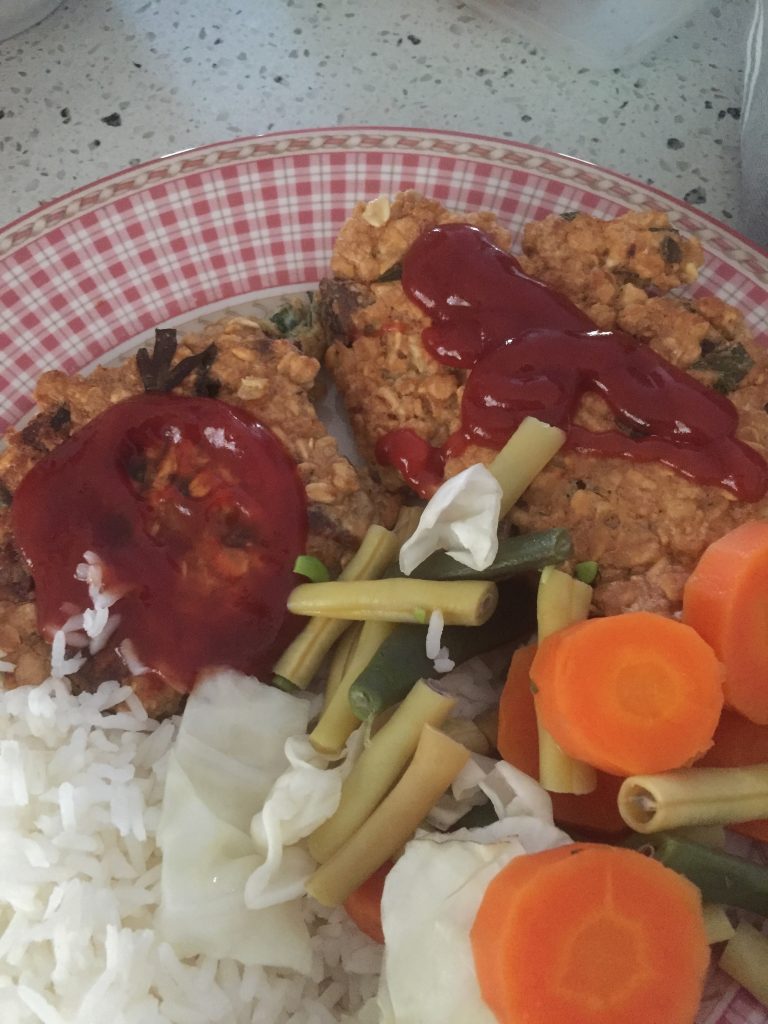
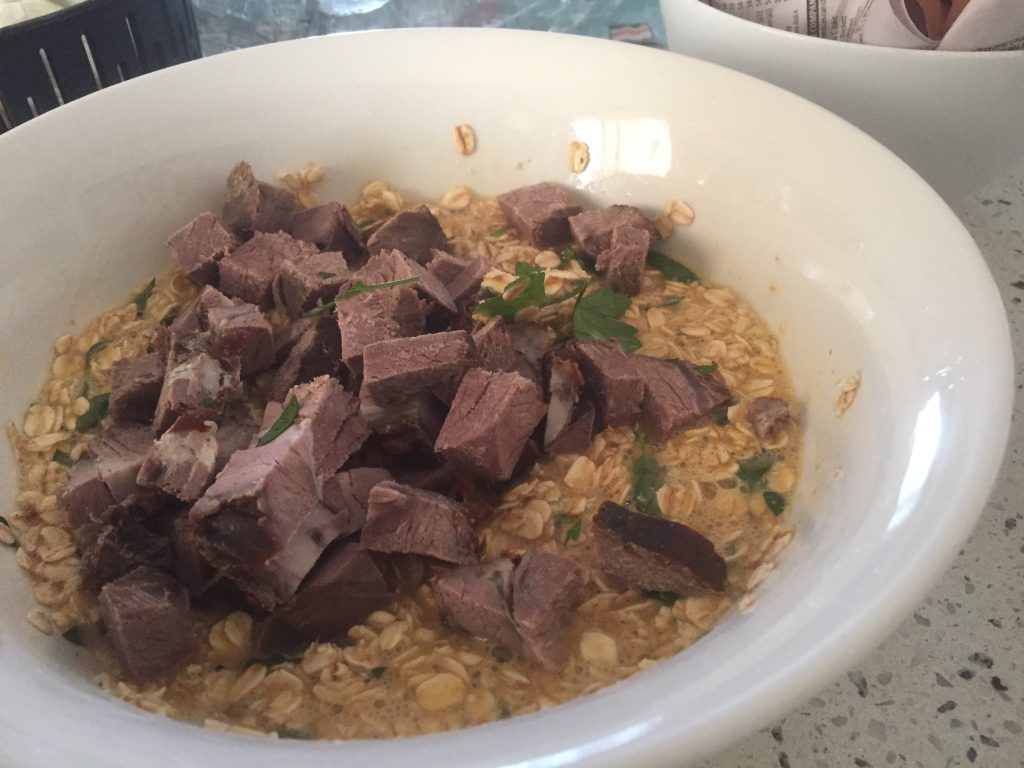
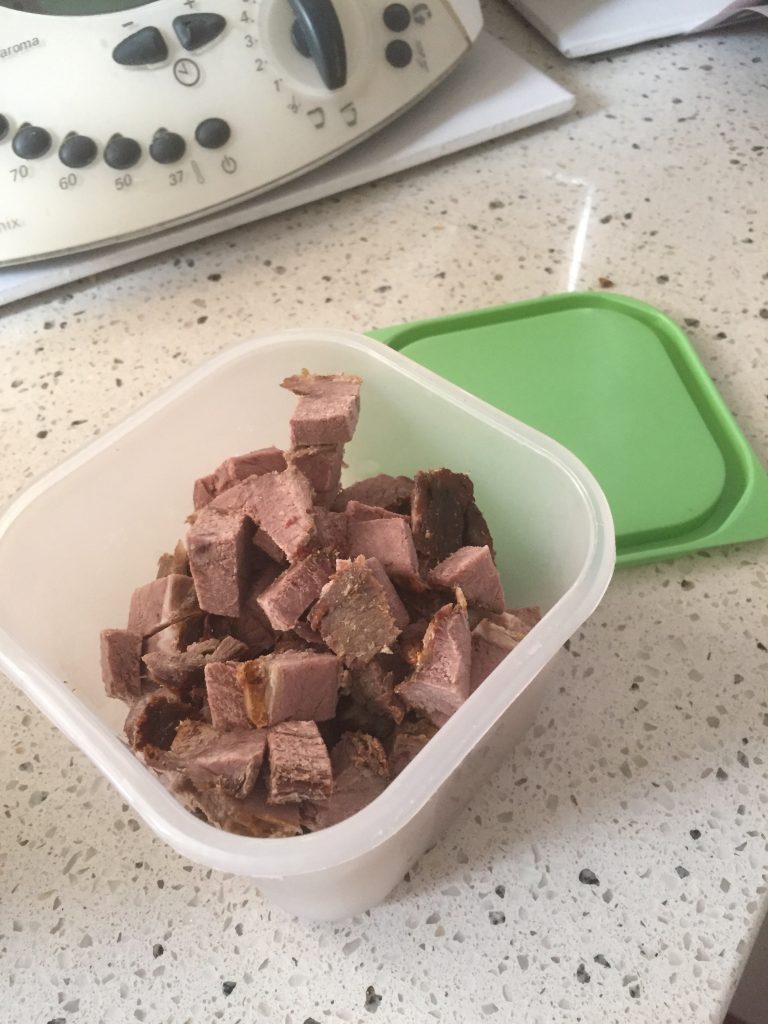
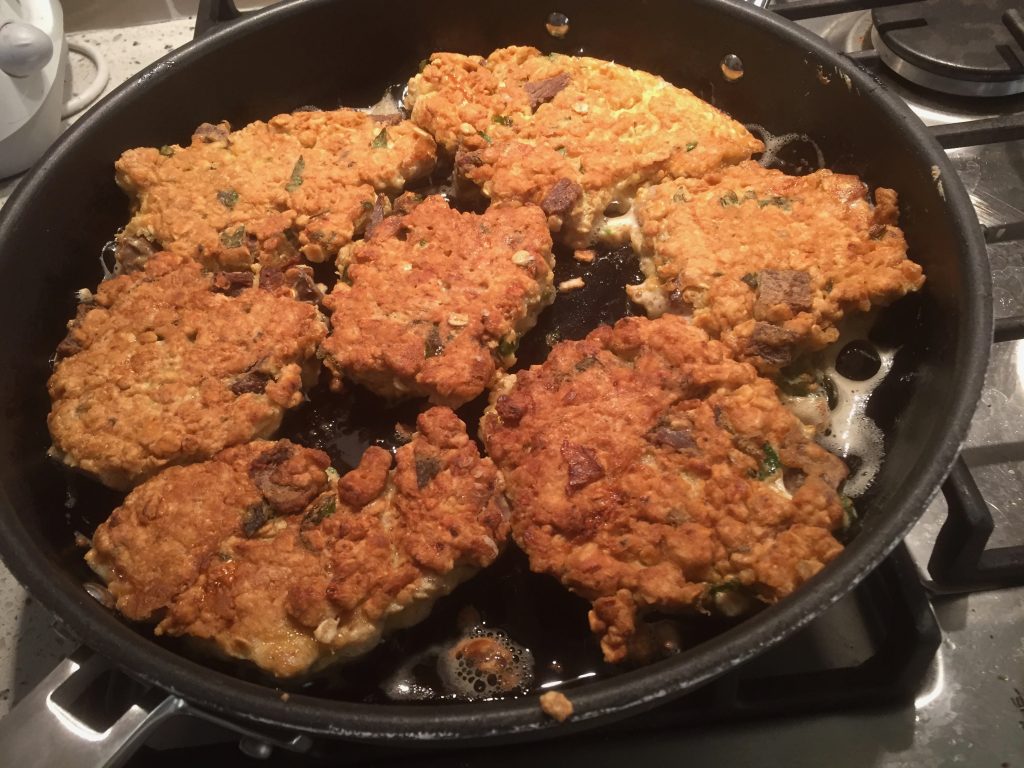
It’s a gourmet mix of raw eggs, rolled oats, salt and some dried or fresh parsley that you form into patties and shallow fry. If I had some leftover meat, I’d chop that into small chunks and add that too, but often, particularly in the early days, that wasn’t an option.
Smother with lots of tomato sauce and serve with mashed potato and veggies.
Sounds appetising, doesn’t it?
Ok, I know some of you are feeling slightly ill at this point. But Oakcakes are surprisingly tasty, especially with the ‘fancy’ addition of the meat chunks. The tomato sauce is a must, though.
This was bare pantry desperation cooking. I needed something filling and nutritious for the boys, yet it had to be something that they’d all eat because I couldn’t afford to throw uneaten food away. If something worked with all 4 of them, (or even 3 of them), it was in high rotation.
Now that they’re all in their twenties and two of them don’t live at home any more, I’ve started ‘Sunday Roast’. Every Sunday lunchtime I make a roast for whoever wants to come. The added bonus is that there are often leftovers for Mondays and Tuesdays.
A couple of months ago I came home from work, looked in the fridge and thought about what I was going to make for dinner that night. The two boys were going to be in, so it was the three of us. The weather was a little cool, I didn’t feel like making a salad-y thing, hmmm what to do?
Then I remembered Oakcakes.
I suggested them to Ryan24. His eyes lit up.’That’s a GREAT idea! Oakcakes! I love them!”
David 25 was also enthusiastic.
So I mixed up the mixture… which is a strange sentence to type… put the potatoes in the thermomix to make mashed potatoes and prepped the veggies.
Now… this is confession time. The one thing I used to hate about Oakcakes is cooking them. So I got one of the boys to do that. As a responsible parent, it’s my job to prepare them for Real Life by making them do the household chores that I dislike.
But how funny life is sometimes.
The food that I made for them when we were so poor is now their comfort food. Since that meal, we’ve had Oakcakes every couple of weeks after a Sunday Roast when we’ve had lamb or beef. The boys, especially Ryan24, are the ones asking for it and it makes their night when the answer is, “Yes, we have some leftover roast. Let’s do it!”
I can’t help wondering if we are the only family where this has happened. Are we weird or do you have a similar tale to tell about how something – doesn’t have to be food – morphed over time from “survival strategy” to ” delightful comfort zone?”
I’m sure we can all identify with Principal FI – it must be awful to think you’re going to get a day off and then you don’t.
Anyway, please jump across and read the interview I did for him on his ‘Educators on FI/RE’ series. (Sounds like something the kids might do to stay warm if the school was snowed in!!!)
This is an interview that, when it came out, I read and thought, ‘Yeah, I’m really happy with this one.’ I’d like to thank him for allowing me to share with his readers.
Before you read this post, could you please jump across to the blog tournament I’m competing in and have a read of the post in Game 2 with the tag ‘GIFT’ – if you like what you read could you please sling a vote my way? I had lots of fun writing that post and it has a lot of useful takeaways.
HERE IS THE LINK. Then, please come back to read this post. I had a lot of fun writing this one, too!
(Friday, period 2, Year 8 English.)
There’s a lot to be said for attacking tasks in a huge rush of focus, urgency and… if you have a deadline looming.. panic. You can get a lot of things done in a short period of time. But there’s also a lot to be said for using snippets of time to chip away at things. Tasks don’t get done so quickly, but they still get done.
Every English class I teach, I start off with 10 minutes of silent reading or writing time. The kids bring in any book they want to read, either fiction or non-fiction and they have 10 minutes 5 times a week to enjoy themselves with whichever they want to do.
Some kids hate reading, so they can write. Each kid has a dedicated A4 exercise book that is their own personal space to write whatever they want to. This writing is never marked/graded or checked for spelling, punctuation and grammar. The kids are allowed to simply express themselves.
The research finds that the more writing kids are allowed to do, especially ‘low stakes’ writing, the better their skills get. A child who decides to write for most of the 10-minutes in each class will get 50 minutes a week of writing under their belt. By the end of the year that’s a lot of time to practice and improve.
Right at this moment, there are 3 minutes remaining of my year 8’s 10-minute time on Friday. They’re absolutely silent, most of them reading, but some are writing.
I told them about a couple of year 7 kids I had last year.
One boy, Jack, is a mad car enthusiast. On his first reading time, he asked if he could write about why the Mercedes XYZ (whatever it is) was so awful. When he finished it he let me read it and I was blown away. It read just like an article in a car magazine. Bythe end of the year he had 2 big exercise books filled with articles, stories and rants – all about cars.
Another boy got an idea for a novel while he was writing in class, so in every English lesson, he wrote a little bit more of it. His novel would never have been written if he hadn’t used these little slivers of time.
That’s really powerful.
(Friday, period 4, year 9 English.)
Ok, I’m now in front of my year 9 class. I’ve given them the huge ‘rev up’ talk about how these 10 minutes every day are probably the only time they’ll get to choose what they want to do in a usual day. I’ve told them to take advantage of the freedom to either consume something they want to read or create something they want to write. It’s silent. Again, most kids are reading but some are writing.
Using little snippets of time can add up to really substantial results.
Actually, it just occurred to me that we bloggers are the poster children for this. We write WHAT we want to write, we write WHEN we want to write and we put it out there. I’ll guarantee you that after a year or two, most bloggers who look back at their early posts wince and wish that they could do a re-write because their writing has improved so much. The writing has only become better because we keep coming back to it.
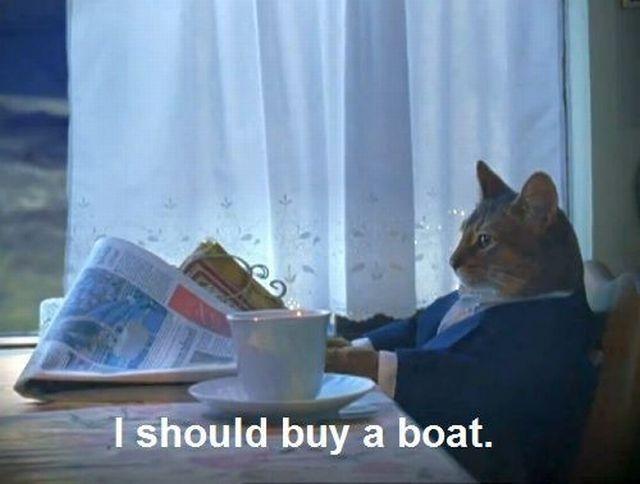
All of the bloggish writing that we do is being done in little moments of time that we squirrel away from our day-to-day lives. For example, in the last 7 minutes of lunchtime, I found the memes for the first 2 images in this post. I knew I had to get to class when the bell went, so I used the time I had available to get a little job done.
(It’s now Monday, period 3. I’m looking at my year 8 as they read or write.)
Going on from what I was writing last week, little bits of time are usually SO productive. Your phone rings, you pick it up and someone says, “Thought I’d drop in. I’ll be there in 10 minutes.” It’s AMAZING how much housecleaning you can get done in that time! (Or is that just me?)
(Monday, period 5 – a year 10 French class I’m supervising.)
I remember years ago, when my Dad was standing in my front yard with me. The garden was overgrown and weeds were everywhere. I sighed, really disheartened, and he turned to me and said, “Never forget, Frogdancer, people move much faster than weeds can grow. Any bit of time you spend out here means you’ll be in front, because you can pull the weeds faster than they can spread. “
I’ve never forgotten his words, mainly because he was expressing the bleeding obvious. Why is it that we can never think of these things ourselves, but the minute someone else says them you recognise the truth in them? He was right – if you decide you’re going to pull out weeds for 5 minutes a day, eventually your garden will be weed-free.
Even the biggest tasks can be achieved if you keep coming back to them.
I was worried about whether I’d stop writing so much for this blog after I went back to work. I’m addicted to reading and I was using the 10-minutes in each class last year to get my Goodreads challenge done. It helped – I read 72 books last year, which still fell 8 short of my target. However, what if I swapped some or all of the reading time for writing time? Hmm… I’d still be modelling creative behaviour for the students which is what a good teacher does…
How could I make this work? I began by lowering this year’s Goodreads target to 60 books. I decided that I’d use the 10-Minute morsels of time on blog posts during the week while saving big chunks of time for writing on the weekends and I raised my blogging target to 3 posts a week. I included ‘Write Every Day’ and ‘Post 3X a week’ columns on my chart that I started at the beginning of the year.
(Tuesday period 1 – year 7 English.)
I’m only in my second week back at work, but so far its been working like a charm. I’ve written things for the blog every single day. It’s easy on the weekdays – as the kids read or write I’m tapping away on my keyboard – but even on the weekends I make sure I’m productive. I hate having to record on my chart that I didn’t do something!
There’s a lot to be said for long swathes of time where creativity has the chance to sit and ponder and let ideas mature and develop. That’s what the weekends are for. But there’s also merit in giving yourself a tight deadline with little smidgens of time and letting productivity go wild.
I thought it might be fun to include the periods that I was writing this post in, so you can see how the 10-Minutes works. I’ve also been editing as I went along, which is why the lengths of the writing during each lesson varies. It wasn’t because kids were talking and I had to take time to shut them down. The kids really love this time. Anyway, hope you enjoyed it!
(Thispost was prompted by J. Money at Budgets are Sexy He posted a tweet about an ad he saw that said something like “No outfit is complete without a diamond!” I tweeted back and said, “Every outfit I wear has a diamond with it! My engagement ring. Except I wear mine on my right hand. I call it my Freedom Ring.” He said I should blog about it, so here it is.)
Some might say that wearing a diamond ring from a defunct relationship is the very essence of frugality. Why buy yourself jewellery if you already have something lying around? Now, I’ve been known to be reluctant to spend money if I don’t need to, but the Freedom ring has a bit more behind it than just wanting to save a few bucks on bling.
Way back in 1985, my boyfriend popped the question and I accepted. It wasn’t exactly a surprise, as we’d been living together for around 18 months. We were in the city having lunch, then after we finished we went straight to where my cousin worked.
He’s a diamond-setter.
I wanted an emerald ring… not your usual wishy-washy faded green emerald but one that was a deep, brilliant green. My cousin John showed us all the emeralds he had in his office, then when none matched up he left us there to go downstairs to borrow some from another jeweller who might have the colour of emerald I wanted.
While he was gone, A said, “Frogdancer, I don’t want to buy an emerald. I want to get you a diamond. A big diamond. That’s what I’ve had in my head.”
I really wanted the emerald – after all, the emerald was what I’d had in my head! – but I thought, hey, A is paying for it so I should really get what he wants. I know, I know… I was going to be the one wearing it, but I was young and stupid back then.
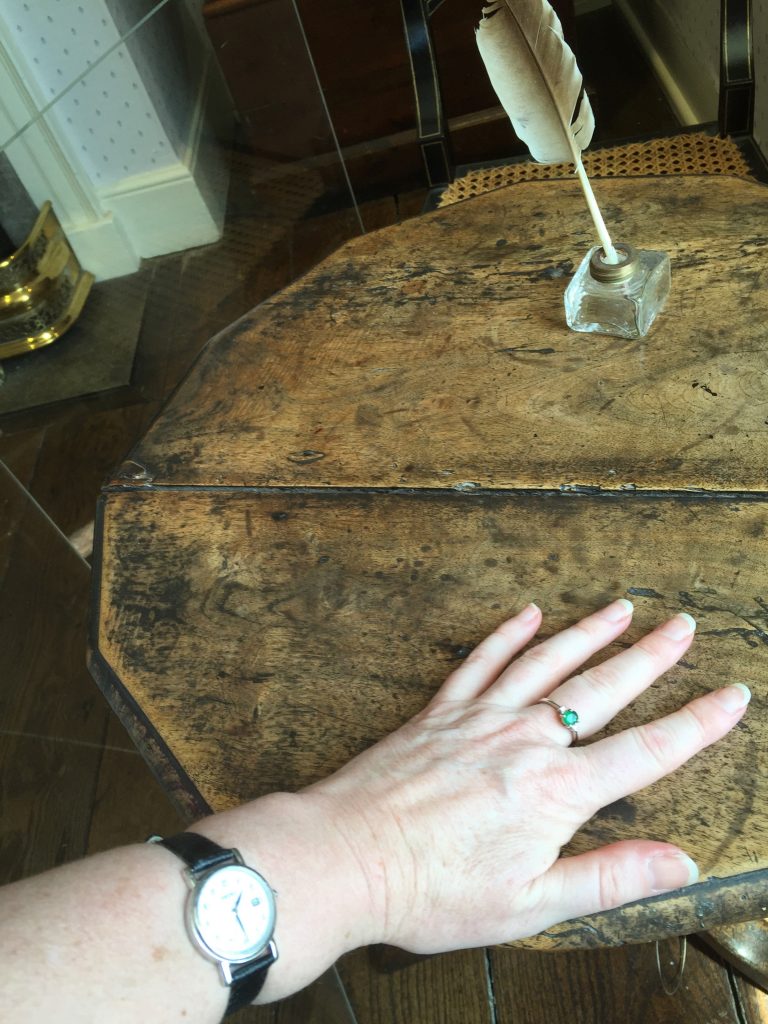
Anyway, it doesn’t matter. See this photo? This is taken in England, with my hand touching the actual table where Jane Austen wrote her novels. See the ring? It’s an emerald that I bought for myself when I took the kids to Thailand. Dreams DO come true!
But I digress.
When John came back into the room, carrying a box full of emeralds, we said we’d changed our minds. He laughed and said that this happens more often than not.
He put the emeralds down and asked A how much he was willing to spend.
“Five thousand dollars,” he replied.
I nearly fell off my chair. Back in 1985 that was a LOT of money.
In fact, I just googled what it would be worth today and I nearly fell off my chair again. The equivalent amount in today’s dollars is FOURTEEN THOUSAND SIX HUNDRED DOLLARS.
I gaped at him. I thought he was mad. But I certainly wasn’t going to say no.
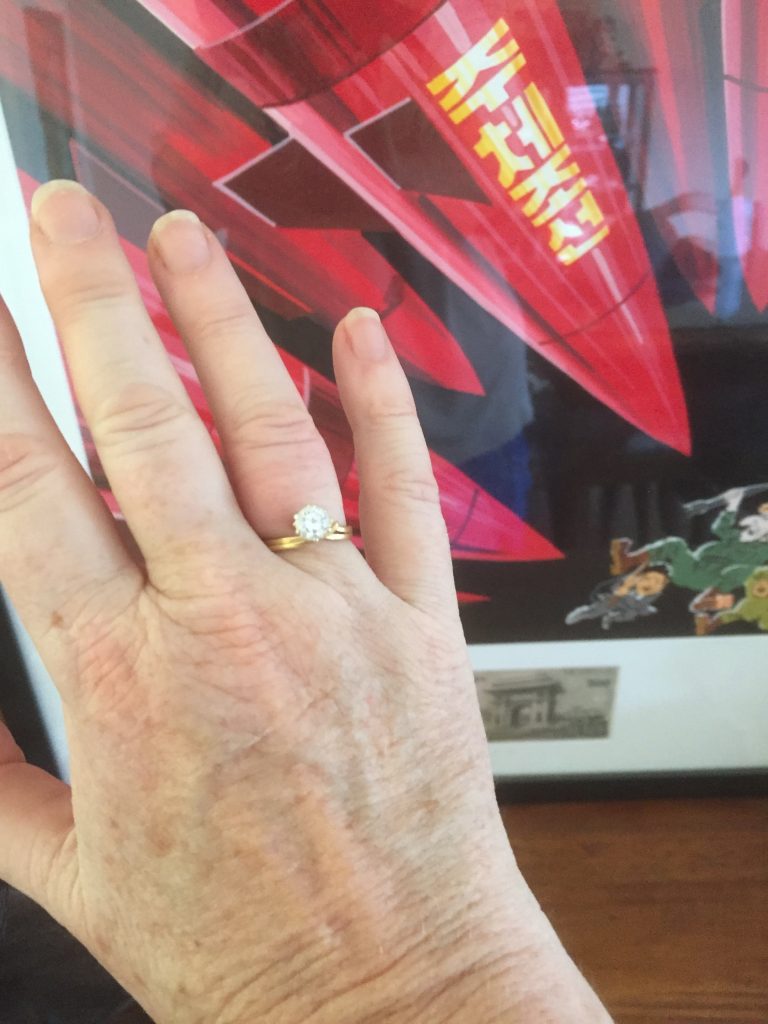
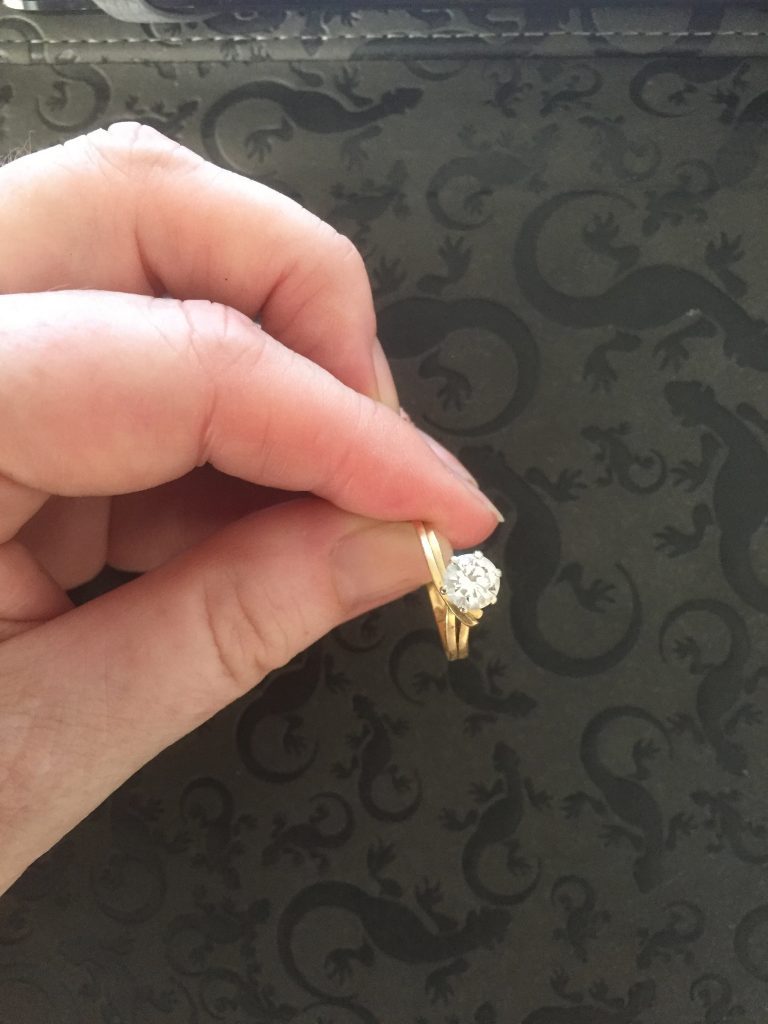
John nodded, got up and came back with diamonds. This is the ring we designed:
Everyone called it “The Rock.” I can’t remember just how big it was, but it’s just over 1 carat and it’s of very good quality. The wedding ring was designed to fit under it. It’s gold because he wanted gold – everything else I wear is silver – really, I should have realised back then that this relationship wasn’t destined to work!
We got married in 1987, had our 4 children from 1992-1996 and I left him a year later in 1997.
During the ‘discussion’ in front of the registrar from the Family Court when we were doing our financial settlement, A asked for many things. He wanted the furniture, the car and more of a share to the house than he was entitled to. The registrar was getting increasingly disgusted with him, considering we had 4 small boys to consider. Finally, A asked for the engagement ring to be returned.
The registrar turned to me, rolled his eyes and said, “And how do you feel about that, Mrs Married-Name?”
“After 4 kids and 10 years of marriage, I feel I’ve earned it!” I said.
For a few years the ring languished in the bottom of my jewellery box. I didn’t want to wear it. Then, one day, I took it out and put it on my right hand. There it stayed for a few months, until one day, when I was at work, I glanced down and saw, to my horror, that the claws of the ring were empty.
The diamond was gone.
I searched, but I had no idea when it had gone missing and you can’t search an entire school to look for a pebble. I was upset, but what can you do? I put the useless ring in my jewellery box and went on with my life.
Two years later, Evan came out of his room, holding something in the palm of his hand. He would’ve been around 9 or 10, I suppose.
“Mum, I found this in the corner of my sock drawer. What is it?”
I gasped as I looked at what appeared to be a weirdly-shaped stone. Could it be? I turned it over and it gleamed.
Talk about Fortunate Frogdancer!
After John put the ring back together again – “I was so sorry when you lost this diamond. It’s a beautiful stone” – I put it back into the jewellery box. A and I were having child support ‘discussions’ and I didn’t need the reminder of him.
And there it stayed until around this time last year.
I sit near a group of women in our staffroom who are in their late twenties/early thirties. They’re all in that stage of life where they’re getting engaged/married/buying houses/having babies. We were talking engagement rings and I was describing mine. Alice said, “Why don’t you bring it in? I’d love to see it.”
That night, I opened my jewellery box and sifted through the contents until I found the box. I opened it and the diamond shone. I looked at it and remembered so many things. My wedding, the babies, the good times as well as the bad.
I smiled as I slipped it onto my ring finger. The ring finger on my RIGHT hand.
The ring has been there ever since. The girl that it was designed for has long gone and the woman I am now has taken her place.
On the surface, it’s still a beautiful piece of jewellery and I take pleasure in looking at it. It’s simple and elegant, (both qualities that I aspire to be one day) and it goes with everything.
On a deeper level, every now and then I glance at the ring and I think of that girl in my cousin’s office, excited at the new life in front of her and having no idea how it was all going to pan out. She made so many mistakes, deferring her own judgement so many times – but I suppose without all of those mis-steps and blunders my life wouldn’t look the way it does today.
I have a nickname for the ring on my right hand. I call it “The Freedom Ring.” It’s a symbol of how you sometimes begin a journey and end up in an entirely different destination to where you thought you were going to be.
Some of you may remember the post I did early in the summer holidays, where I went mad buying clothes, after not having bought many in the last 5 years.
And it’s been great! I’ve had a week of swishing through the front door of the school, people complimenting me, kids also saying nice things about my level of style, sophistication and downright beauty… I’ve been having a ball. But there’s just one problem with all of these new clothes.
Linen looks much better when it’s ironed.
Now, I’m not stupid. I knew this up-front. As I was standing in the fitting room at David Jones with roughly 4,000 different items of clothing I’d dragged in to try on, I looked at myself in the mirror and said, “Frogdancer Jones – if you buy any of these clothes you have to start ironing again.”
*sigh* I bought about 2,000 different things. Around 120% of them are linen. Or at least that’s how it feels right at this moment.
When we moved to The Best House in Melbourne nearly 3 years ago, I threw out the ironing board cover. I’d say that it “didn’t spark joy” but that was long before anyone heard of that expression. Ever since then, if I ever needed to iron anything I’d put a towel on the bench in the laundry. David25, clearly not a fan of this work-around, bought his own ironing board for his work clothes and just before going back to work, I borrowed it to start the year off right.
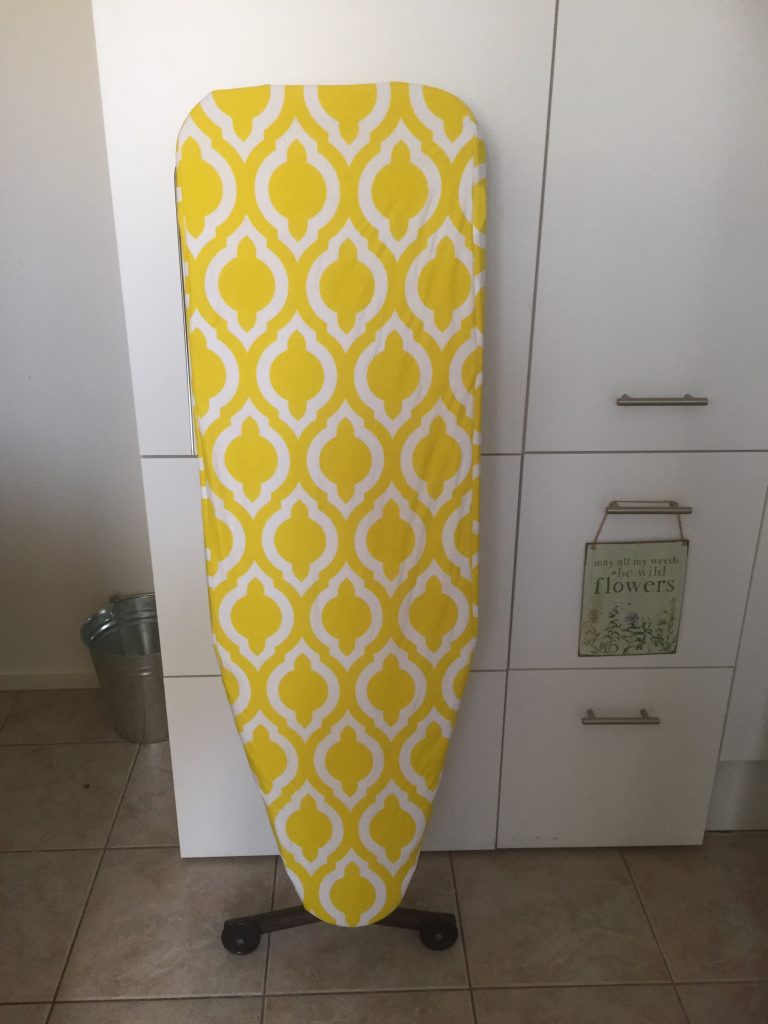
The next day he did a Bunnings run to get a few things that he needed and he came home with an ironing board for me in my favourite colour. I was touched – and also resigned to my fate. There was no excuse now!
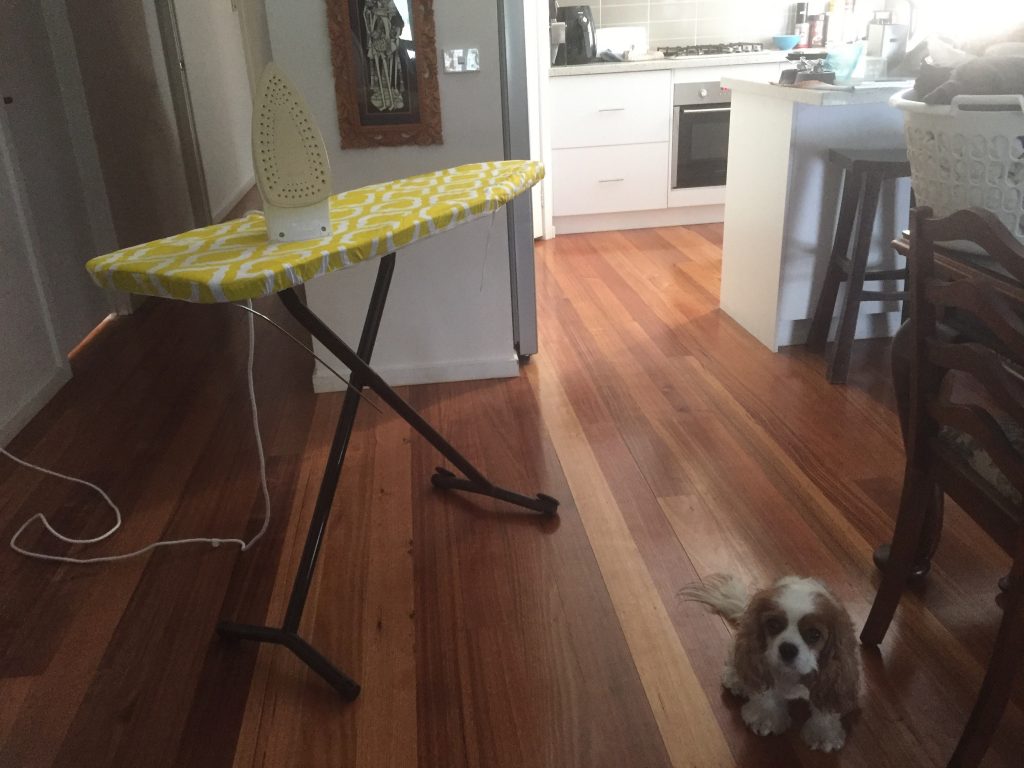
I set everything up in the lounge room. It was stinking hot outside and the cooling was on. Poppy, who is my keen ‘halper’ with everything, was a bit bewildered by this new item of furniture.
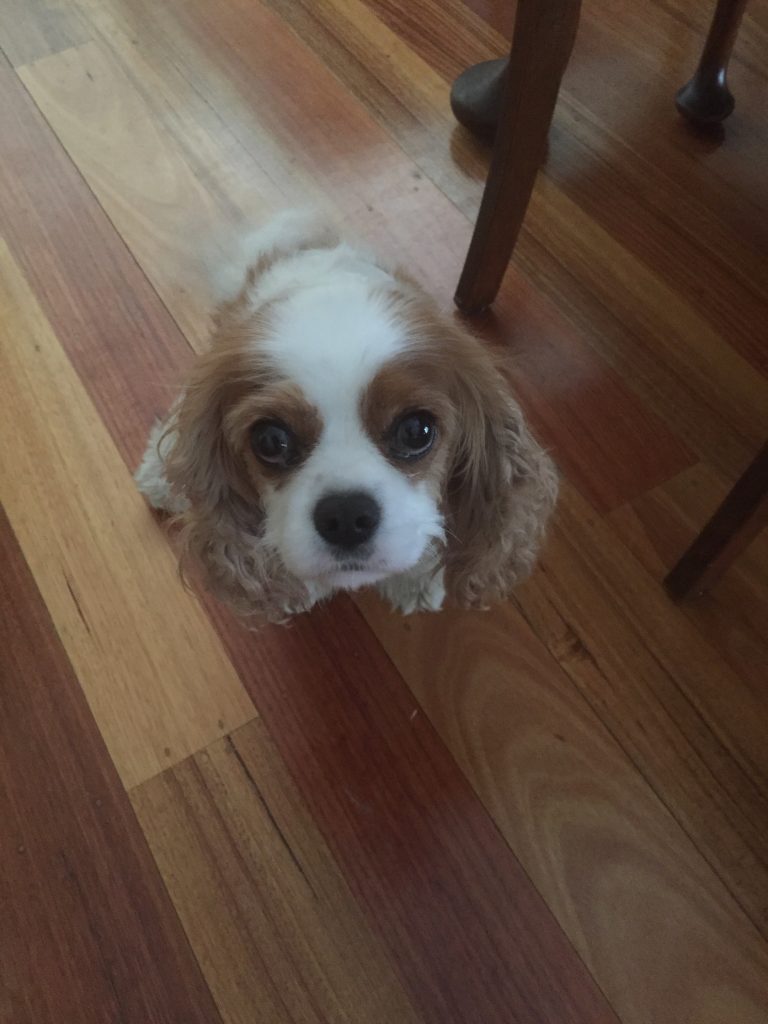
Close up shot. I think she’d prefer it to be IN the kitchen rather than near it, so she can have a sporting chance of getting something to eat.
I looked at my watch. It was nearly 4:40PM on a Sunday afternoon – twenty minutes away from Wine O’clock. I could do this.
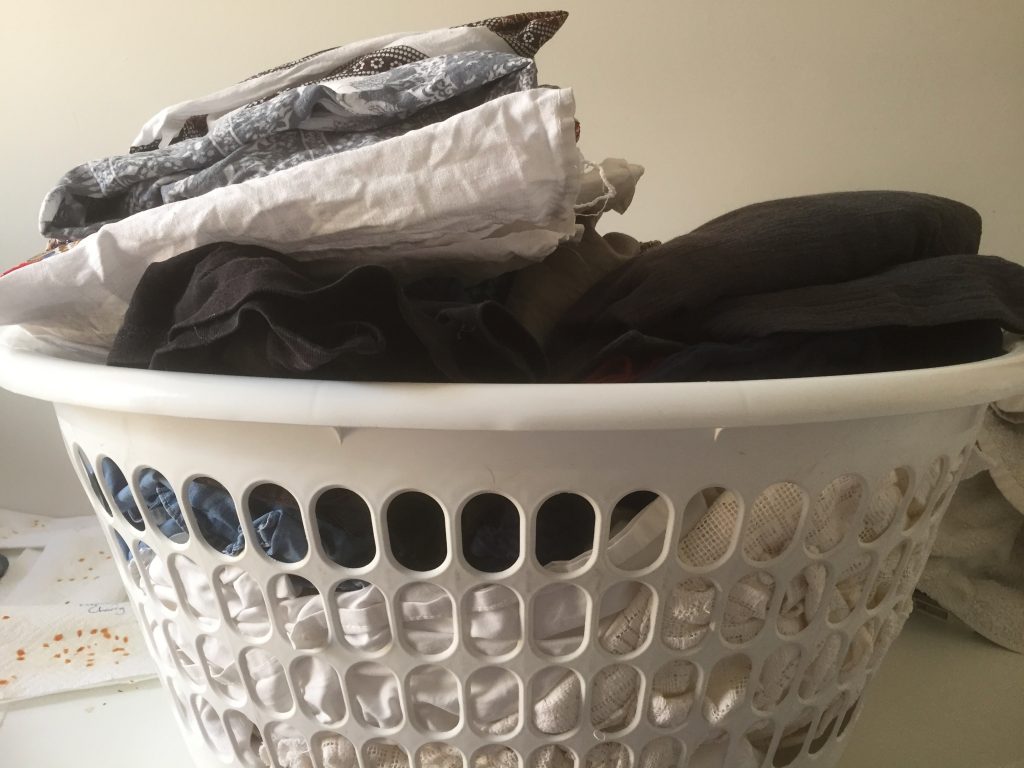
The bottom things are the Christmas tablecloths. They can wait. I grabbed the first item of clothing – some Bali pants Mum and Dad brought back for me the last time they were there – and I set off.
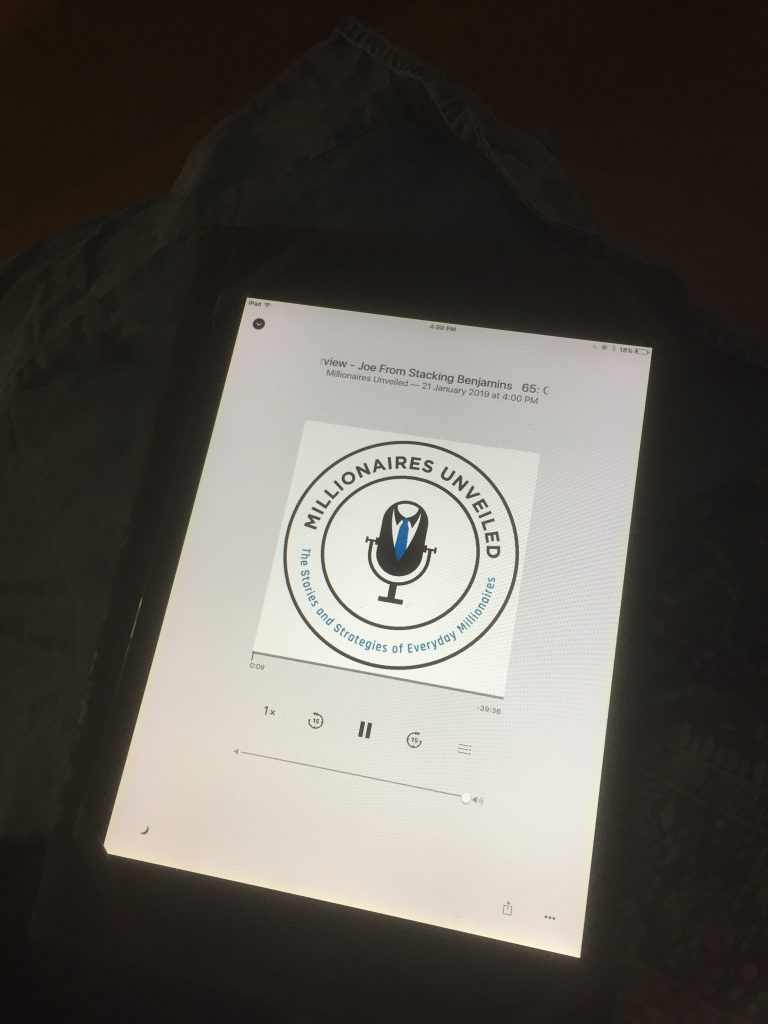
Of course, I had a podcast on. This was a really good episode by Millionaires Unveiled, where they were talking with the guy from ‘Stacking Benjamins.’ You could do worse than listen to an interview they did a few months ago with a single mother from Australia called Frogdancer Jones… just saying.
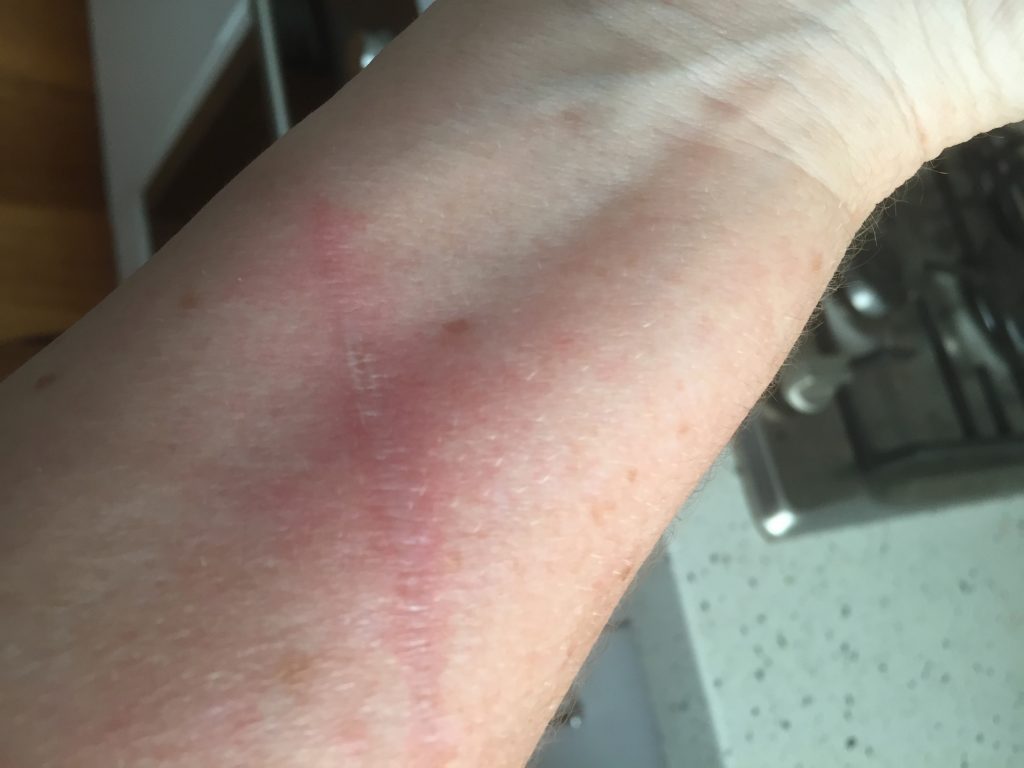
I didn’t escape unscathed. Stupid iron. You’d think someone would invent an iron which would move out of the way.
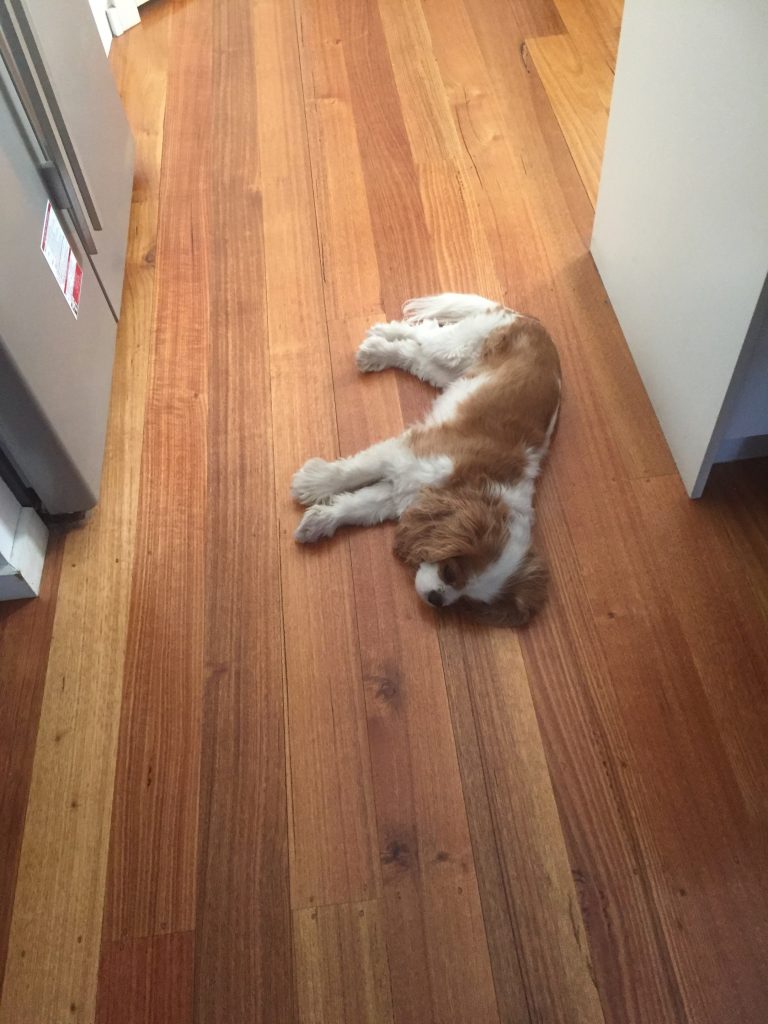
By the time I finished, the podcast was over, my arm was sore and Poppy had given up on me completely.
But Scout was watching. She had a ball ready and waiting for me to throw.
So what’s the financial takeaway from this post? Seeing as this is a FIRE blog and all. Maybe… when you practice delayed gratification to reach your financial goals and then you finally get there – it makes sense to look after what you reward yourself with.
Or maybe I felt that I’ve written quite a few serious posts and it was time to mix it up a bit.
Something happened on the second-last week of the holidays and I’ve been thinking about it ever since.
I was walking the dogs around the block. It was mid-morning and for some reason we had left it too late to go to the dog beach. We rounded the corner near the primary school and there was a woman sitting at the bus stop, talking on her mobile.
“Yeah, I’m on my way home,” she said as we passed. “I was volunteering but it’s finished now.”
I glanced at my watch, thinking, ‘It’s only 10 o’clock. How could a job be finishing up now?’ I shrugged and then kept walking. The sun was shining and the dogs’ tails were wagging. It was all good.
As we walked further up the street, an elderly lady and her son were walking towards us, pushing a trolley loaded up with boxes of fruit and vegetables. I could see that they were commenting about the dogs, so as we got closer I smiled and we stopped to exchange a few words. Her son looked to be in his forties and he had Downs Syndrome. He was torn between being taken with the dogs and worried that they might bite. His mother, who was clearly his carer, reassured him and we talked briefly about the dogs, then we moved on again.
As we kept going, there were another couple of people walking towards us, also loaded up with bags of what looked like shopping. I thought nothing of it and kept going up to the corner, where the church is.
As we got closer I could see people coming in and out of the church hall. They were wheeling shopping trolleys in and carrying boxes full of food out. It was a hive of activity in there.
This was on a Thursday morning, when I’m usually at work.
A woman and her husband were coming along the path towards us, so I pulled the dogs in beside me to let them pass. The woman stopped and after the usual compliments about the dogs, said, “Do you know what’s going on in there?”
When I shook my head, she said, “They’re giving away free food!”
I glanced towards the church. “Really?”
“Yes. It’s so wonderful. My son is starting year 7 this year so we’ve been buying books and uniform and paying the school fees… it’s so expensive. I was worrying about how we were going to pay for everything, but look at all this!”
She gestured to the boxes of produce that her husband was carrying.
“This takes all the pressure off. And guess what’s in this?”
She patted the tartan shopping trolley that she was pushing.
“It’s FULL of lunch box snacks! Like LCMs and Uncle Toby’s. I won’t have to worry about school lunches for ages! You should go in and have a look.”
I laughed and looked at the dogs. “I don’t think they’d like it too much if I brought the dogs in with me!”
She urged me to go in again, then she found out I was a teacher and we talked about starting secondary school She was nice enough to thank me for being a teacher, which (to be frank) is a bit of a novelty. Most people whinge about the holidays we get, especially at this time of the year!
As we headed towards home, I could see quite a few people heading for the church, shopping trolleys and bags in hand. If I hadn’t have talked with the woman outside the church, I would never have noticed them.
I didn’t go into the church to grab some free food, because it wasn’t put there for people like me. I have a full-time job, my kids are grown and I’m financially secure. But my head was spinning.
Because you see, it wasn’t so long ago that it would have been for me.
Back when I was at home with my 4 small boys, money was tight. I was watching every penny like a hawk and it was definitely on the cards that if something went wrong financially, I could lose the house and the kids and they would lose that security. It was incredibly stressful.
Then, one day my Aunty Doris asked if I’d be interested in getting free bread every week. Her brother-in-law was a member of a church that sent people to pick up everything that wasn’t sold at a gourmet bakery in East Brighton and then deliver it to people who needed it. The Tuesday night woman couldn’t do it any more and he thought of the boys and me. I couldn’t believe my luck!
We went to that bakery every Tuesday night for the next 14 years. We’d drive into the laneway at the back of the shop, armed with 3 or 4 empty laundry baskets and lots of plastic bags. It wasn’t just bread – there were cakes and buns, pies and pasties… it was a lucky dip every week.
The boys ate a LOT of bread growing up. Every Tuesday night was pie night. We’d eat whatever hot food was there. We grew very tired of pies and pasties but I insisted we keep the tradition going. That was a night where feeding the 5 of us didn’t cost me a cent!
It was a crazy thought that we were so poor, yet we were eating the same bread as the “rich” people in East Brighton. Some of it was your ordinary white loaves, but mixed among that was the BEST rye bread and gourmet wholemeal seedy loaves that I’ve ever eaten. Nothing better than a chewy crust of rye bread with lashings of butter. Now that I’m writing about it, I really miss that rye bread…
After a few years we bought chickens. Every Wednesday was bread day for the chooks, which saved me a day’s worth of pellets. The neighbourhood birds soon got to know our backyard – it wasn’t an unusual sight to see a raven flying away with a Boston bun in its beak and sparrows snatching dinner rolls and squabbling over them.
Every week, I’d pack the leftovers from the bakery into different laundry baskets, depending on who was going to get the contents. At first, when I was home with the kids, there was our basket, Mum’s basket, and then various friends who’d put their hands up for free bread. Later on, the chook basket, for the food that wasn’t as pristine. Then, when I went back to work, there was the school basket. Every Wednesday morning I’d walk from the car to the common room, basket loaded up with loaves of bread and all the cakes and buns. People loved that they had a free morning tea every week and that they could take home some bread to use for toast.
When I bought The Best House in Melbourne and moved 50 minutes away, I knew the bread run had to come to an end. I tried it once and the trip home at peak hour along Nepean Highway was awful. I didn’t get home until 6:30. There was no way I was going to make my Tuesdays that long and I knew that times had changed. Although I was paying over 70% of my takehome pay in bridging finance, I knew that we’d be able to survive without it. It was time to pass the baton to someone else.
I walked away from my conversation with the couple outside the church and my eyes widened as I started to recognise how far the boys and I have come. She was once me, with all these bills to pay and barely enough money to keep things going. Once, there is no way I would have walked away from that free food! I would have tied the dogs up on the fence outside and dived in, desperate to save some money so I could put it towards uniforms, bills or servicing the car.
Instead, the dogs and I quietly walked home, seeing the other people clearly making their way towards the church hall. Some were young mothers pushing prams, some were older people and some looked like they’d clearly had a hard life.
I opened the gate to The Best House in Melbourne and brought the dogs inside and bent down to take off their leads. I stood up and looked at my beautiful, fully-paid-for house and I sighed a deep sigh of thankfulness that things have ended up as they have.
I kept my head together and didn’t waste anything while we were struggling, whether it be free bread, donated kids’ clothes or my teaching degree. We were very fortunate to have had help along the way, such as the bakery run and we didn’t squander it. I will be eternally grateful for the impulse that led that man to offer the Tuesday night run to the boys and me. It was a huge help when we were struggling and it also taught the boys about spreading our good fortune by sharing with others.
But the thing I’m now most grateful for? When I looked at that excited woman who urged me to go on and get some of this miraculous bounty for myself and I felt nothing but a calm certainty that this generosity was not for me. I can safely leave it on the table for others to use.
I’m not used to the feeling of financial security. It’s lovely.
Today is the Australia Day public holiday, which to all teachers is The Last Day of the Summer Holidays ( aka day of mourning). The dogs and I slept in till 8 AM, then I took the pups down to the dog beach for the last weekday walk here for a long time.
Keep in mind that when we set foot on the beach it was around 8:30 AM. This time tomorrow, I’ll be sitting in the lecture theatre with the rest of the staff, listening to our principal start off the new school year. There’ll be talk of tirelessly working for the benefit of our students, OH&S reminders, lots of talk of pedagogy (which is just ultra-boring education jargon) and exhortations to keep the standards high, watch uniform infringements and reminders of all the meetings we’ll have over the next two days before the kids come back.
The weather outside will be just like this…
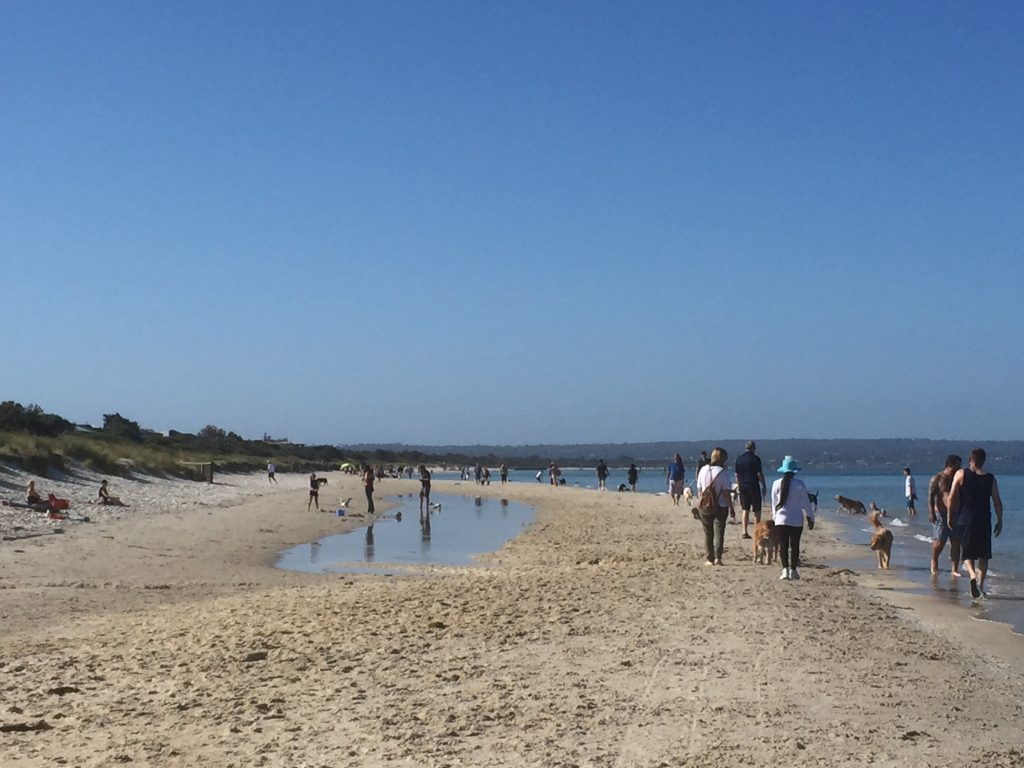
The beach was packed. Every (wo)man and their dog was there. We were all enjoying the moment. Maybe I’ll be doing the same 24 hours from now, but I’m hazarding a guess that it won’t be to the same extent.
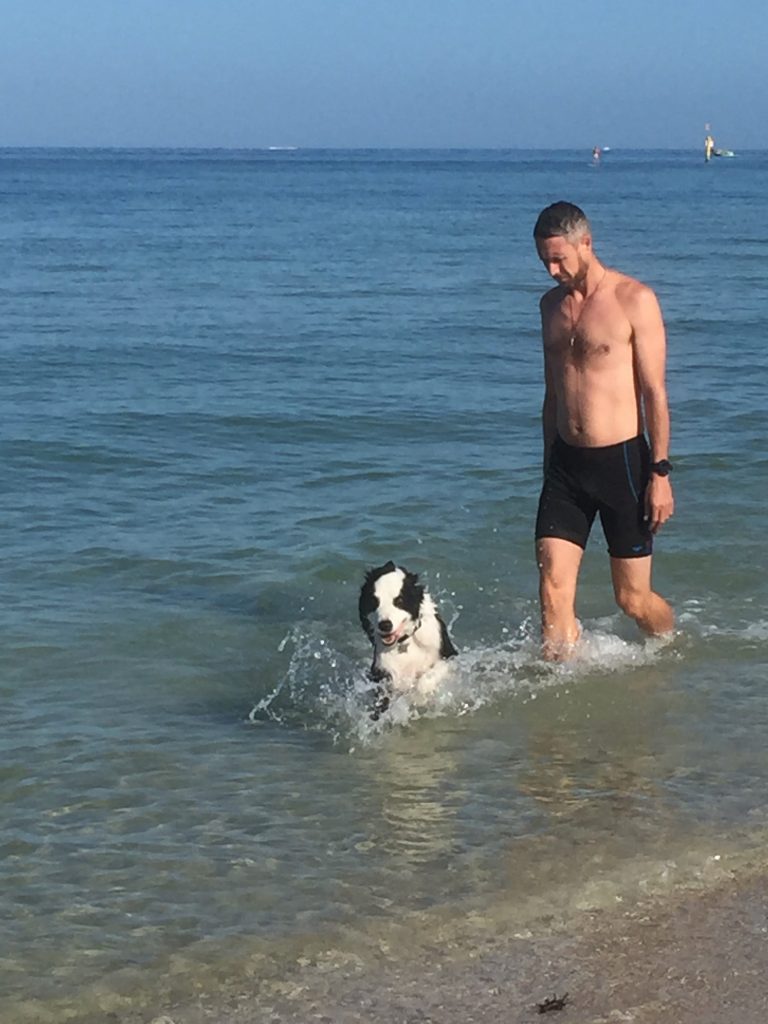
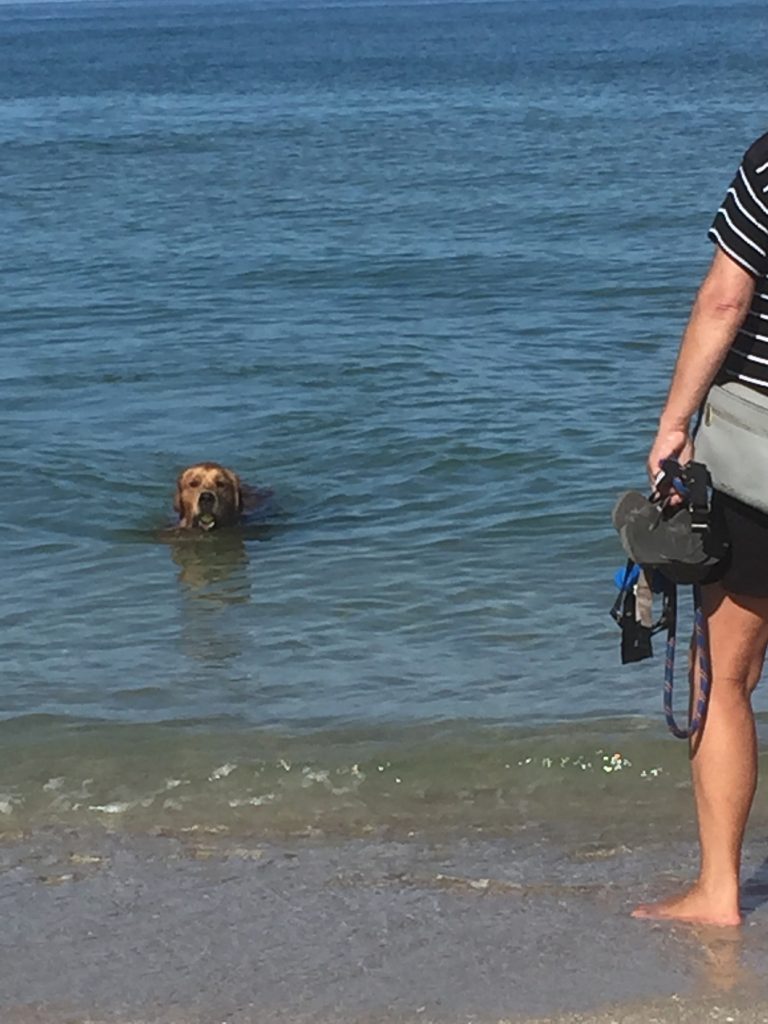
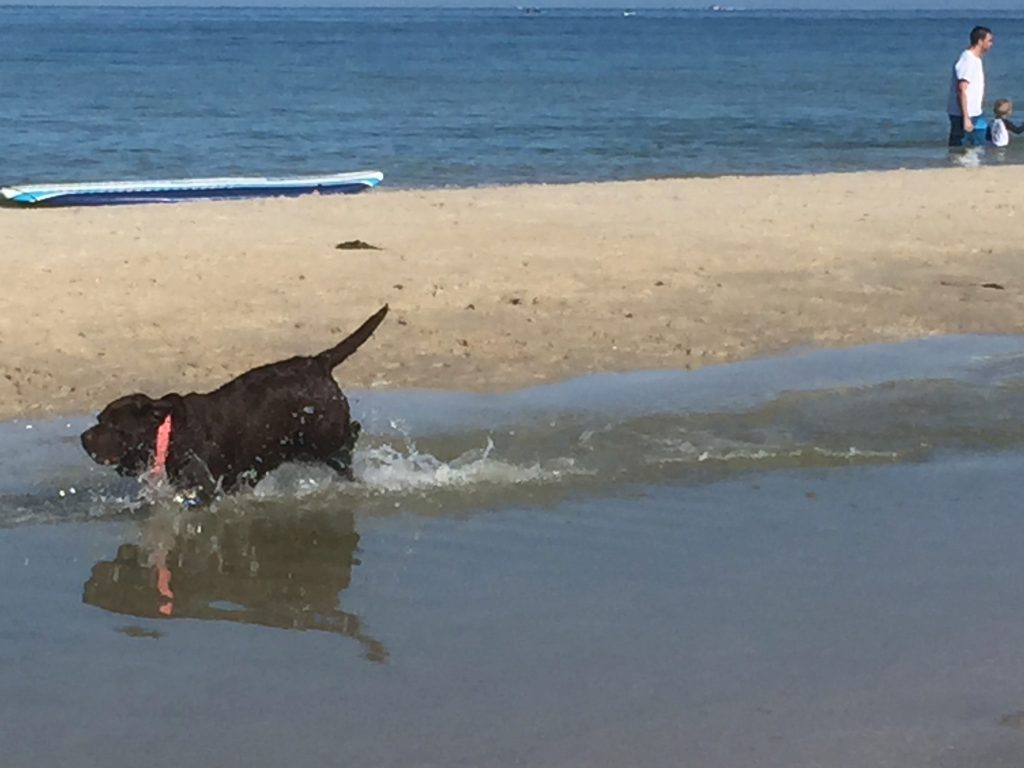
It wasn’t too hot, but the bigger dogs were already enjoying the water.
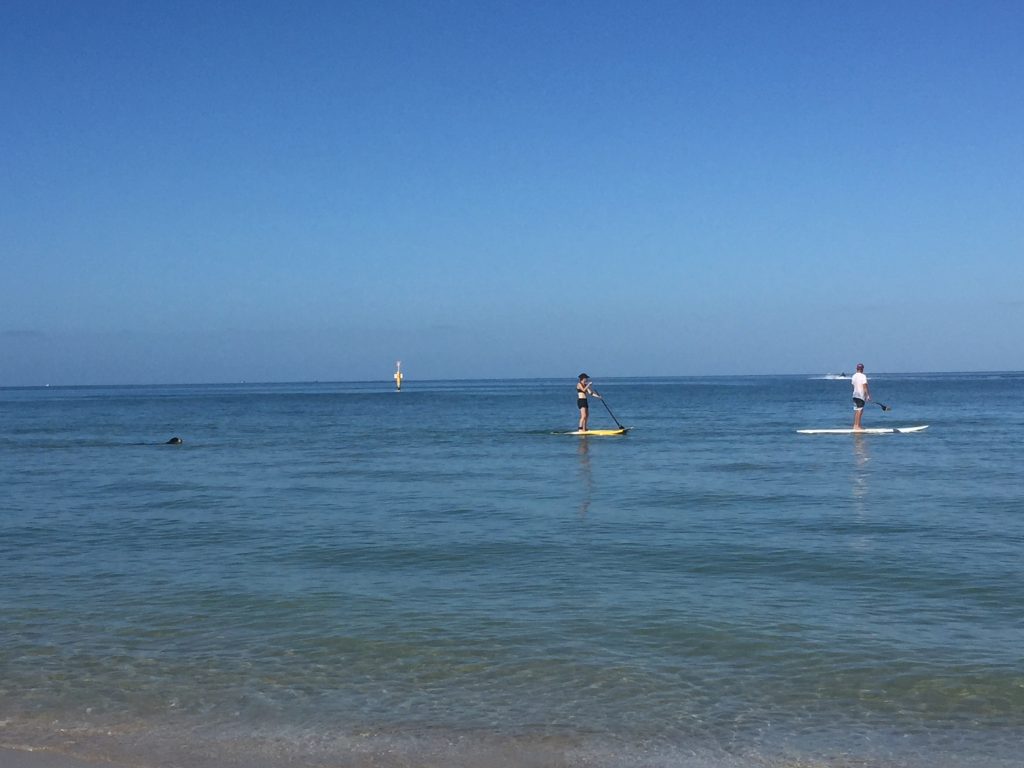
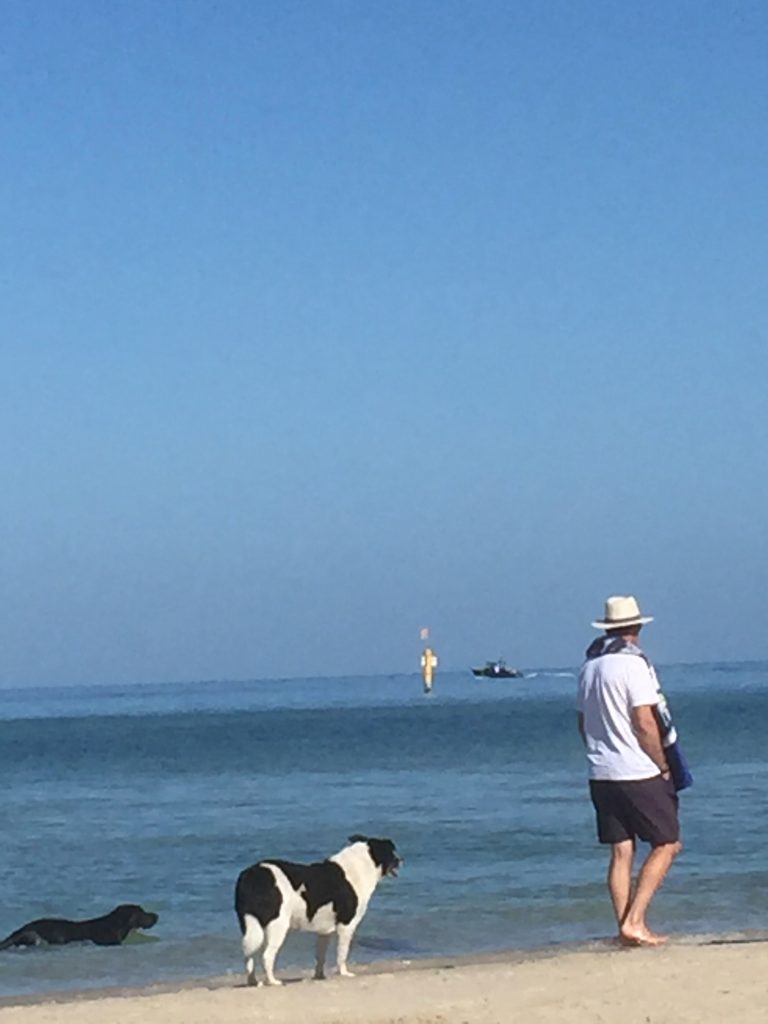
One of them was enjoying the water WAY out with his paddle-boarding owners. See his head bobbing along after them?
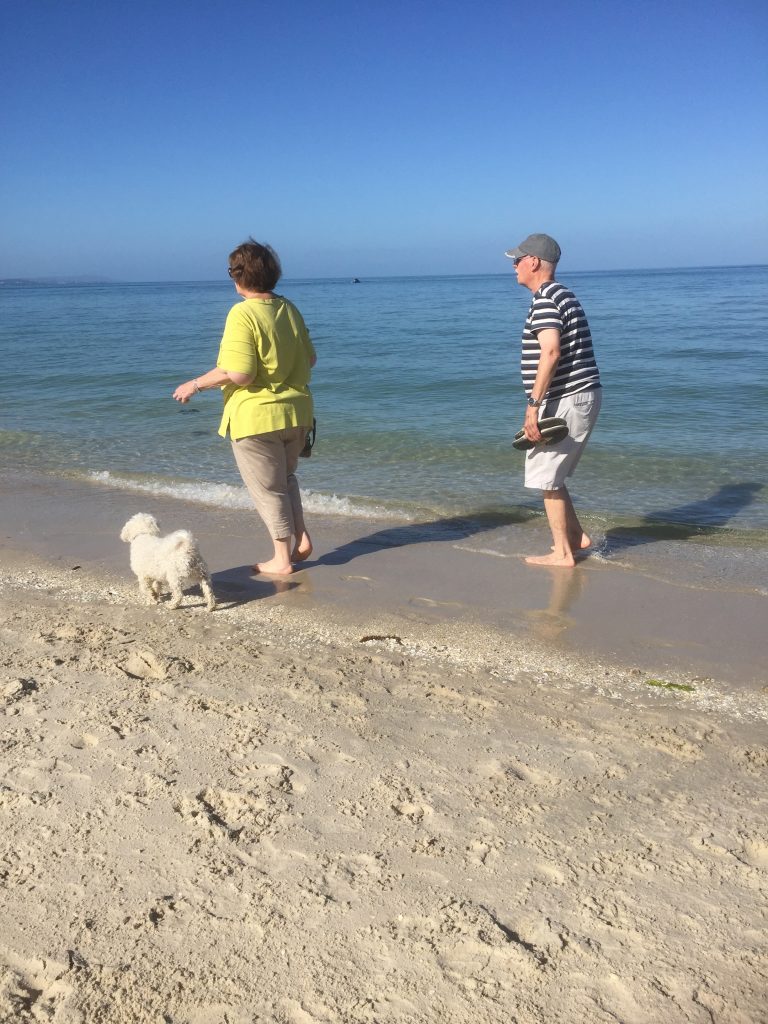
Everyone was taking the chance to get their feet wet and enjoy the public holiday.
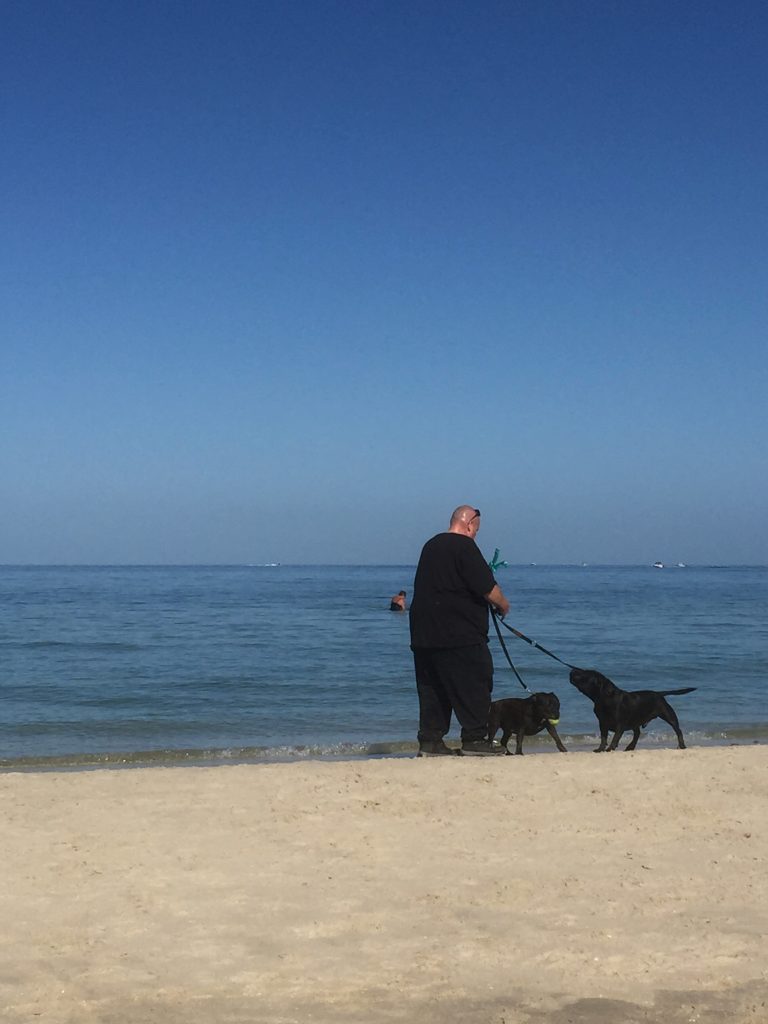
The saying that people grow to look like their dogs sprang to mind when I saw this guy and his staffies. He looked as if he was trying to blend in with the pack.
Scout gets hot on walks when the temperature goes above the mid-twenties. She’s also a magnet for every single dog on the beach to come up and sniff her. She started to stop, refusing to walk with us.
This is what she did when I insisted. Short of dragging her, there was nothing I could do but wait for her. It’s lucky she’s so cute.
This dog’s owner was holding a tennis ball. I had to hold Poppy’s collar so she wouldn’t go in and try to get it. She wouldn’t win the battle for the ball with a staffie!
Action shot.
In Australia, even our sandcastles have nasty creepy-crawlies in them. Can you see it? Someone has a sense of humour!
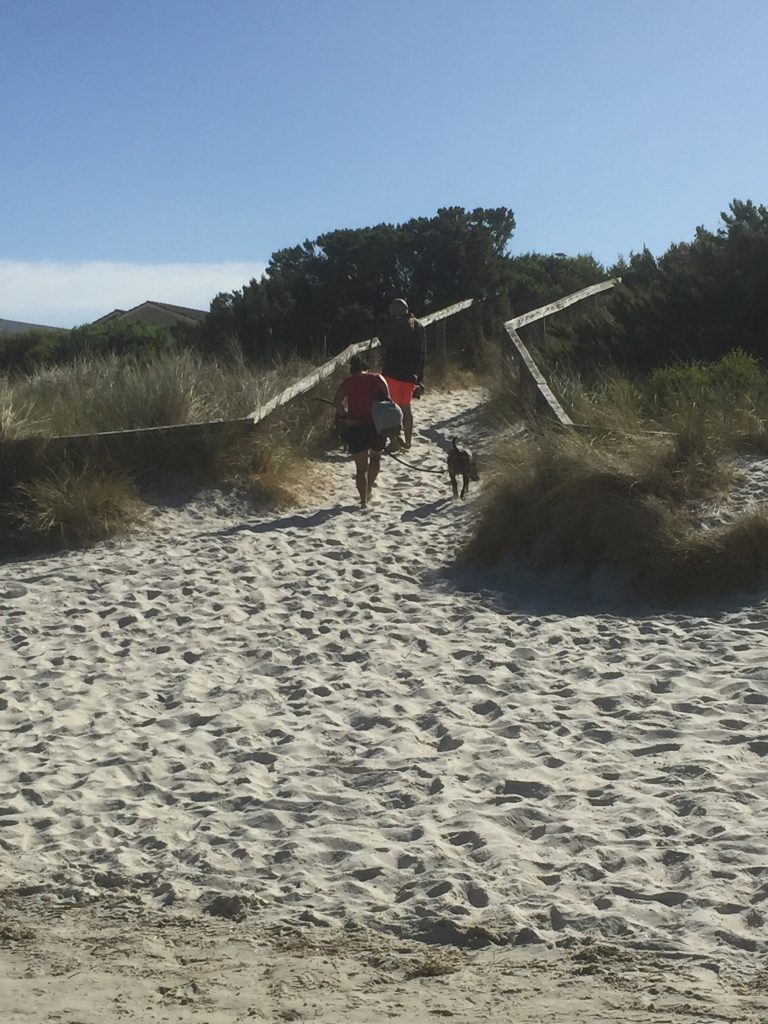
Soon, like these people, it was time to turn around and head for home. The day was starting to get warmer and all dogs had to be off the beach by 10 AM.
I said goodbye to all this blue. It was around the time where, in 24 hours, the meeting would be finishing and I’d be heading back to my desk to get things ready for the classes I’m taking this year.
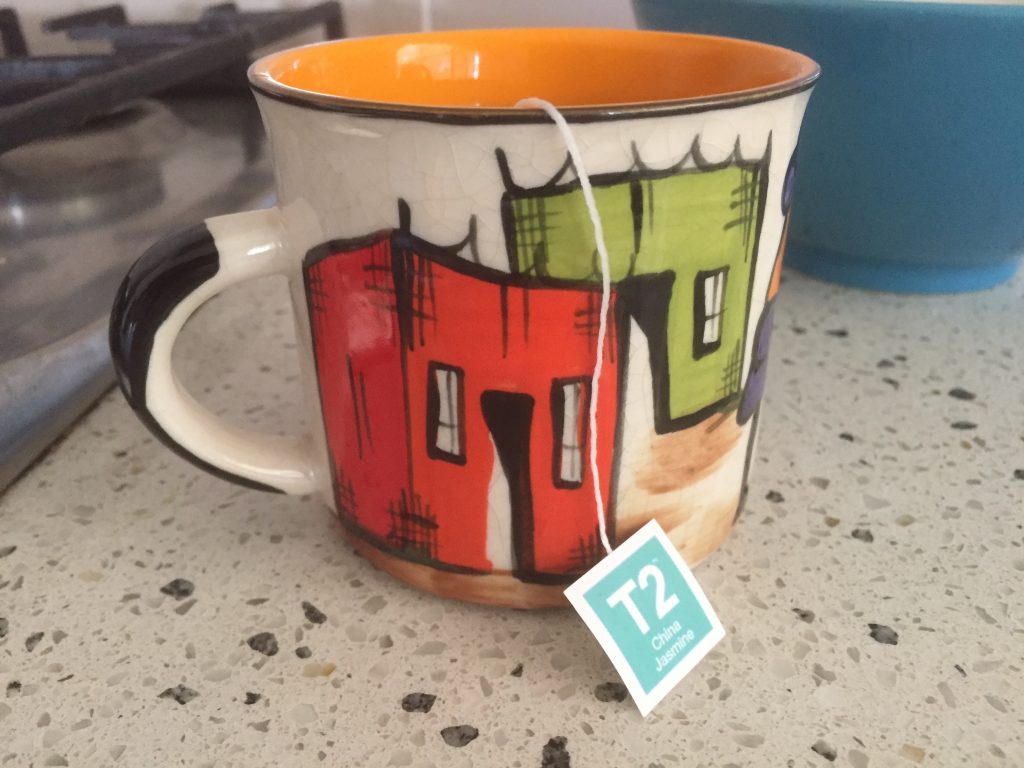
When we got back, I made a China Jasmine tea in the cup I brought back as a souvenir from South Africa. Tomorrow, it’ll be back to the “World’s Greatest Teacher’ mug at school.
(Well, I won’t say it isn’t wrong… Who am I to argue against a mug?)
I’m going to miss spending lazy days with this little crew. Summer school holidays in Victoria run for a little over 5 weeks. This year, I spent the whole time at home.
I didn’t do anything momentous. I spent time with my family over Christmas especially and I saw friends a few times. I pottered around the house and garden, getting a few things done and I read 15 books. I caught up on some Netflix series that I’ve been meaning to watch and I made sure to keep up with the chart I started to try and be more productive. I swapped this site to a self-hosted one and did a lot more writing. I also napped. A lot. Last year at work ended up being pretty tiring for some reason.
Basically, I lived these 5 weeks as if I was retired and it was a normal stretch of time at home.
Was I bored? Not at all.
I guess this ‘beachy’ post is my ode to summer. I’m not sure when the life I’ve been enjoying these last 5 weeks will become my retirement life, but I know that I’ll enjoy it when it comes.
Oh! And if you hear a psychic scream of anguish at about 7 AM tomorrow (Tuesday) morning, Australian Eastern Standard time, you’ll know that I’ve just hopped in the car to come to work.
I love my job, but as I get older I’m valuing having control over my time more and more.
Retirement Reading Quest – Reading my way to ‘free’ council rates.
I’m on a quest to borrow and read enough books to, in effect, cancel out the cost of my council rates per year.
It’s outlined in this post.
Years 8,9 and 10: 2016/17/18 – $5,400
I may as well continue back-tracking. I moved here in 2016, so I’ll chip away at all the rates I paid up till then. I’ll need $5,400.
Running Total – $2,765.
Year 7: I’m already a year ahead on my rates, so I’m taking a reader’s suggestion and I’m going to go back and start covering the rates from the year before I started. I may as well.
Year 7: Total needed: 2019/2020…$1,800
Finished! 12/12/2025
Year 6 (2025/2026) $2,590 AREADY COVERED!!!!!!
10/08/2015 – I won’t have another rates notice until August 2026, so I have time to kill. Let’s knock over a previous year’s rates, just for fun.
Year 5 (2024/2025) $2,339 and dog rego ($63) = $2,435.
Finished it before I even had the new rates notice ready.
Year 4 (2023/2024) $2,413.
Success! Not sure exactly when I passed the total, because I was waiting on the dog registrations to come through. But yes – I blitzed it.
Year 3: (2022/2023) $2,350
12/01/2023 FINISHED! Not working gives me heaps more reading time – I recommend it!