Financially Independent, Retired Early(ish) at 57.

Category: Consumerism (Page 8 of 8)

Frugal Friday: How I spent 2 hours today getting the most bang for my grocery bucks.

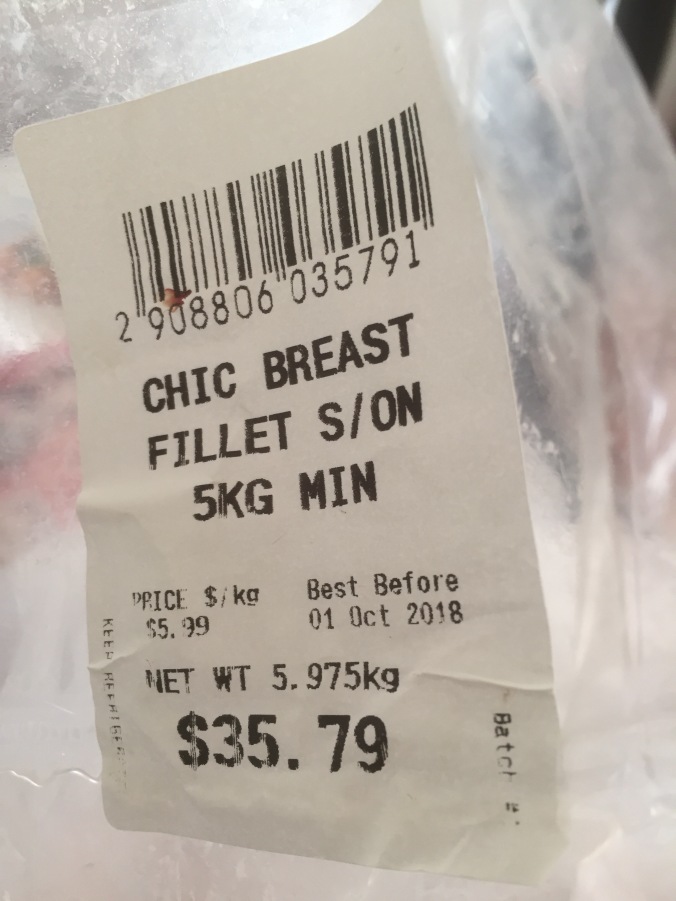
There’s a chicken warehouse about a km away from my place, where I go to buy the chook necks for the dogs’ breakfasts. They have fantastic bulk deals in meat, so every holidays I go there and buy a bag or two of either breast, thighs or drumsticks and spend some time parcelling them up to use in the upcoming term. This time I couldn’t go past chicken breasts at $6/kilo. So cheap!

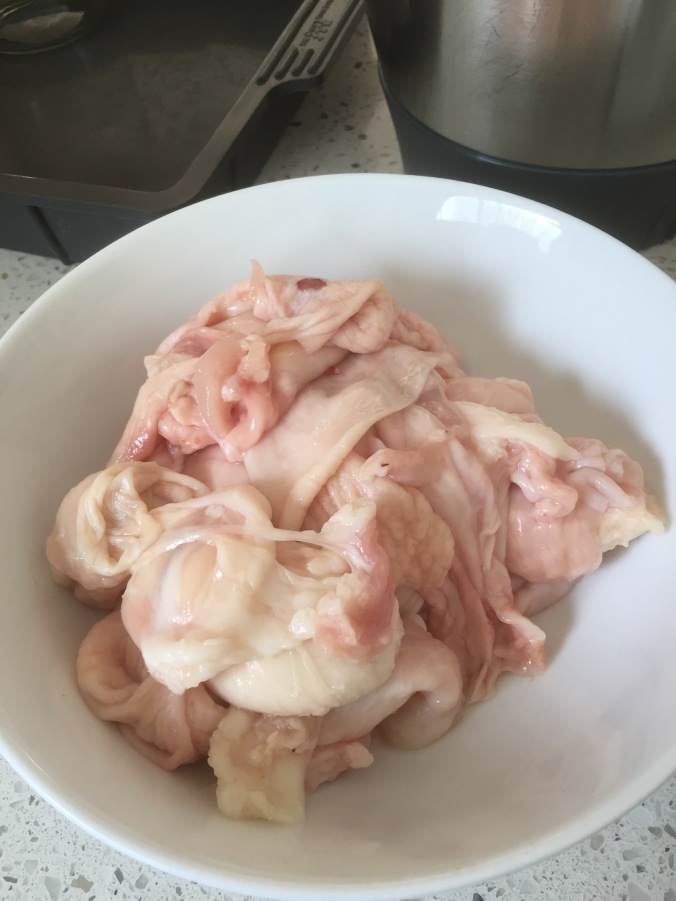
If I’d bought the “skin off” version I’d be paying $2/kilo more. But why on earth would I go that when I have dogs? Tonight, instead of their meat patty and dry food dinner with some yoghurt, I’ll replace the patty with the chicken skins. They’ll be in ecstasy and it’ll cost me nothing.
As I was cooking and chopping and measuring, I thought I’d do a ‘Frugal Friday’ post about everything I was doing today in the kitchen between 10AM and 12PM to save money and make everything stretch a little bit further.

Most of the bag of chicken went into these packaged-up portions. I use Skinnymixers recipes a lot and she tends to have the protein in 700g lots, so that’s what I’ve packaged them in.

I label all my freezer things with masking tape and a pen. Works like a charm. I decided to do this after the day I was running late for work and didn’t have time to make a salad for lunch, so I grabbed what I thought was one of my Emergency Lunches from the freezer. Imagine my dismay at lunchtime when I opened it to find a couple of uncooked drumsticks in some marinade instead of the Butter Chicken I was expecting…

So far I had 6 meals’ worth of chicken to feed 3 adults and have at least one or two lunches left over with each meal. Not a bad start…

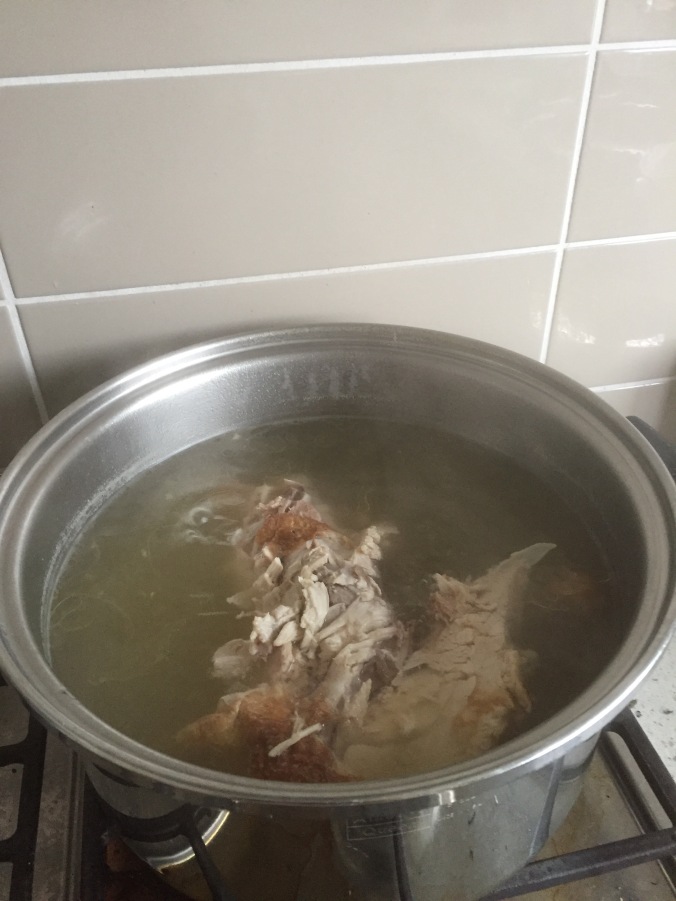
While I was doing this, I had 2 Costco chickens on the stove, making stock. I’d been to Costco a couple of days before and I picked up two chooks. At $6 a pop, how can you walk past them? We’d had a couple of dinners and lunches from them, so today I put the carcasses and the leftover meat into a saucepan of water, brought them to the boil and then simmered them for a couple of hours. I read somewhere that if you add a dash of vinegar to the water it helps draw out the calcium from the bones. I have no idea if this is scientifically valid or not, but I do it just in case.

This is real ‘set and forget’ stuff. I can get 3 or 4 soup bases out of each chicken. It just burbles away on the stove while I’m busy doing other stuff.

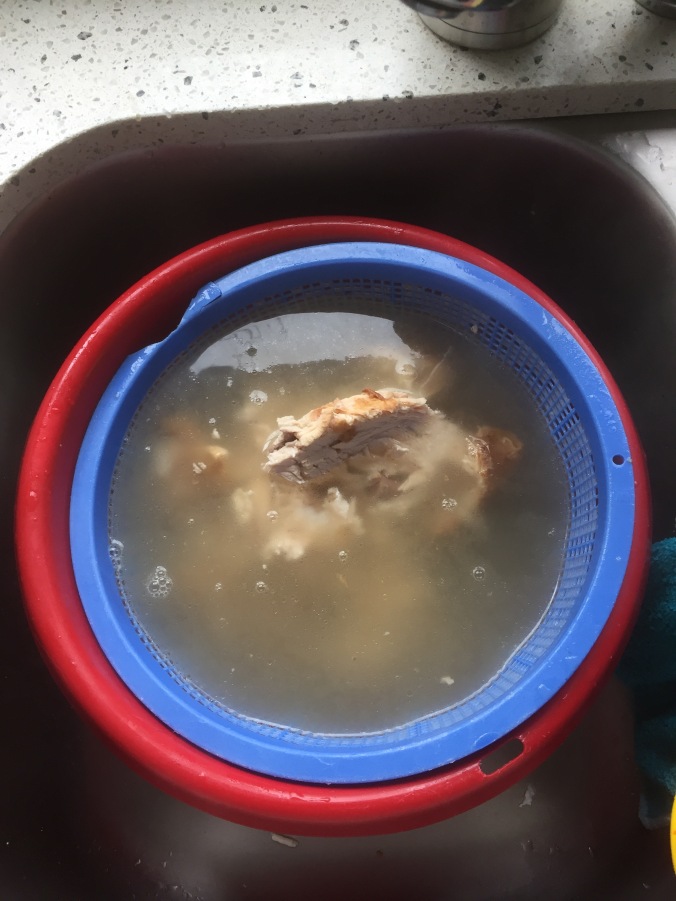
Once it’s done, you drain the bones and meat from the stock.

DON’T do what I did once – I cleverly put the colander in the sink and poured the stock and carcass into it – only to watch all my precious stock go merrily down the drain.

Once the stock cooled a bit on the bench, I popped it in the fridge to get cold. Later, I’ll skim any fat from the surface and pour it into plastic containers to freeze. Nearly every Saturday we have soup for lunch, using up any sad veggies, leftover pasta or rice and things like that. I flavour it with chicken stock paste, or tomato paste, and throw in beans I’ve cooked from scratch and frozen – anything that will be tasty and that I need to use up.

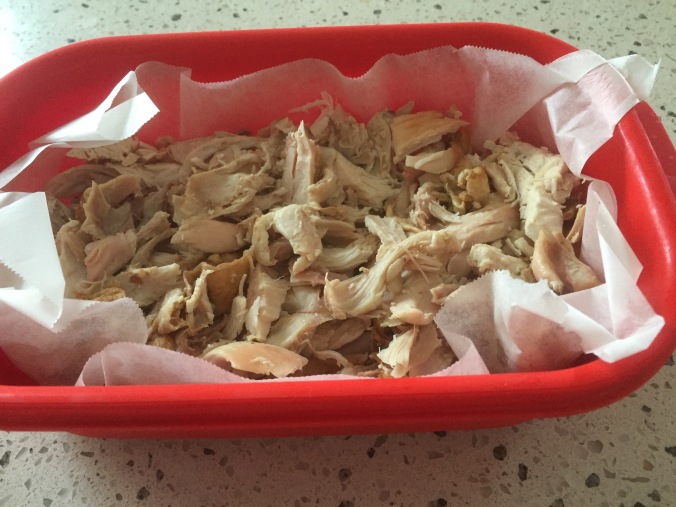
Here’s the meat I saved from one of the carcasses. I’ll probably get 2 soups’ worth of meat from this. I like to freeze them in shallow containers lined with baking paper, so when I take it out to use them I can lift it out of the container and snap off how much I think I’ll need. It’s crazy how much food is left on a leftover chicken that would normally have been thrown in the bin.


I mentioned the chicken stock paste that I make. I had some vegetable stock paste still in the fridge, but I’d run out of the chicken stock paste. Making it yourself is so much tastier and healthier than using stock cubes. You can definitely taste the difference. So I used one of the breasts in the bag of chicken to make some stock paste, while another 700g of meat was used to cook dinner for tonight – a Chicken Tikka Masala. I had both thermomixes cooking this up while I was busy chopping the rest of the bag of chicken into the portions you’ve already seen.

I’d call this stock paste ‘Liquid Gold’ if it was a liquid! It has a heap of salt in it, which is the preservative, and it lasts in the fridge for weeks. I’ll put one jar in the fridge and the other in the freezer and I’ll be right for Chicken Stock paste for the next 6 months or so.

There’s enough chicken skin here to keep three little dogs very happy tonight.

The recipe for the Chicken Tikka Masala calls for 70g cream, but I always use the yoghurt I make myself. I use an old Easiyo container to store it in, but I make it in the thermomix for around $1/litre.

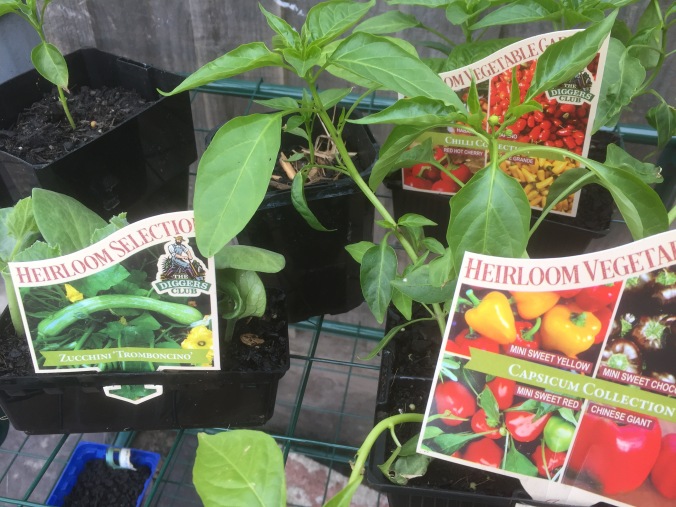
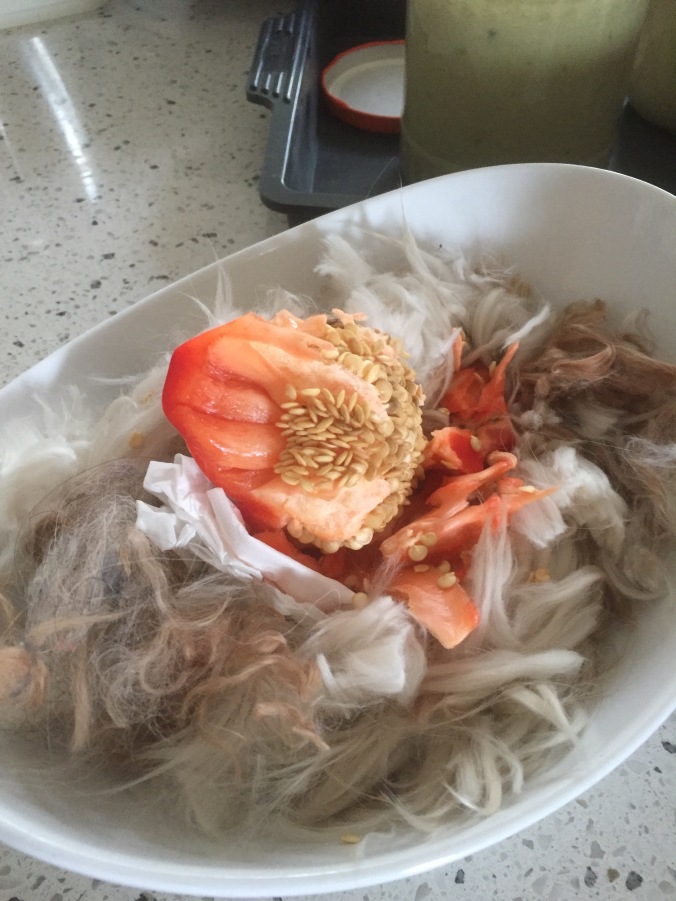
This capsicum was soon chopped up and thrown into the bowl, but have a look at what I’ve got planned to save money here in the future:

Here’s a sneak peek at the mini greenhouse I’ve got. Once the garden gets going, hopefully I’ll have lots of produce chopped up and frozen to use throughout the year. AND all of these plants are heirloom vegetables, meaning that I can save their seed for next year and I’ll never have to buy seeds or plants again.

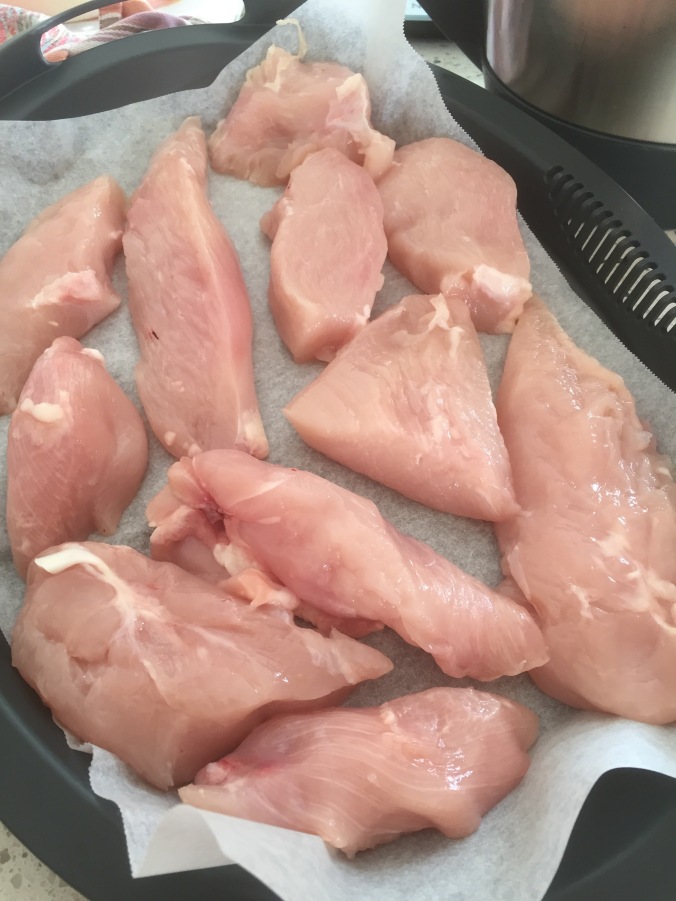
The bag of chicken breasts wasn’t finished yet! Now that Spring is here, I like to take salads, rather than cooked lunches, to work. I decided to steam the last couple of breasts so that I could shred them and use them as protein in my salads or on pizzas.

Here’s a shot of the Chicken Tikka Masala cooking on the left, while the steamed chicken pieces are cooking on the right. Meanwhile, the second Costco chook is bubbling away on the stove behind me and I’m stacking the dishwasher. I have a podcast on my iPad and it’s all happening!

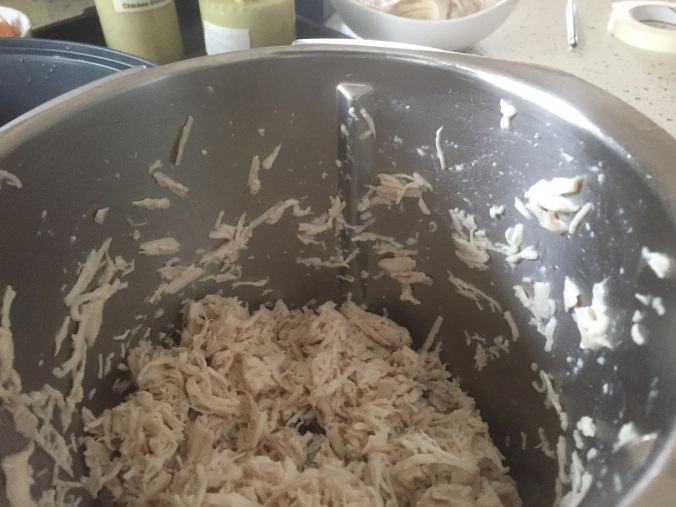
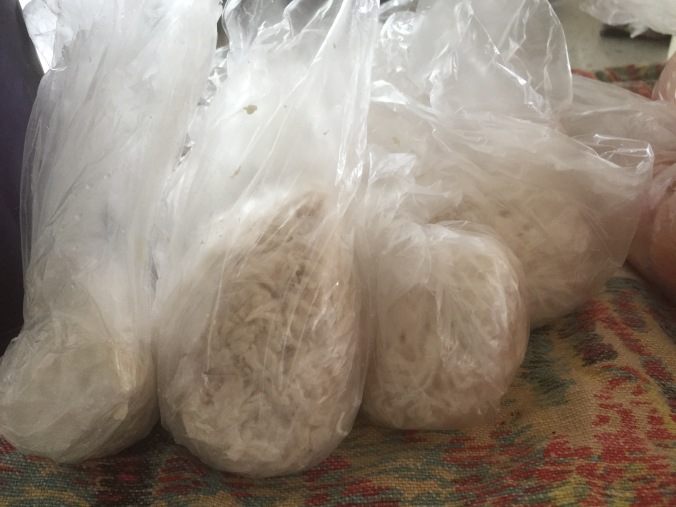
Once the chicken was steamed and then shredded, I portioned it up into small handfuls.

9 single-serve meals’ worth of protein here, either for salads or pizzas. This is making me feel all warm and fuzzy – I love having meals prepared for Future Frogdancer and the boys.

Speaking of preparing meals – here’s dinner. I’ll just have to cook some rice and then the boys and I can help ourselves. There’ll be enough leftovers to freeze for an Emergency Lunch or two as well.

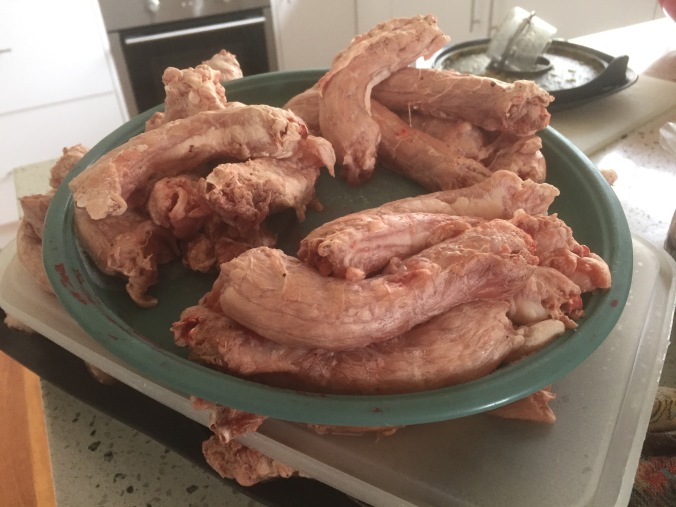
While all of this was going on, I was bagging up the chicken necks that I’d put into piles of 5 and flash-frozen. Each pile is enough for breakfast for the dogs. All I have to do is remember to grab one at night when I feed them, so by morning, they’ll be defrosted. (The chicken necks, not the dogs.)

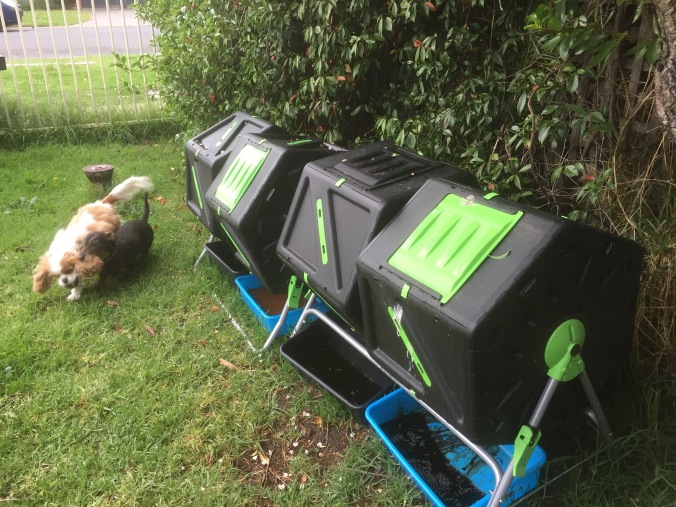
And finally, all of the veggie scraps and the dog hair that Ryan23 cut from the Cavaliers yesterday was put into the compost, so that one day it’ll all be recycled into feeding the plants that will then feed us. Apparently, hair adds nitrogen to the soil. Who knew?

For around 2 hours in the kitchen, pottering around and listening to podcasts, I’ve organised around 20+ meals for us. The main cost was for the chicken, with the bag of chicken costing $36 and the 2 Costco chickens costing $12. (But we’d already had 3 or 4 meals from those Costco chickens…) 

Anyway, it’s impossible to calculate how many actual servings this will all produce. My boys are adults and they are sometimes here for dinner, sometimes not. They eat a lot – they’re men. So some dinners are totally eaten on the night, while others have leftovers that get packaged into smaller lunches for people the next day.

But I like to calculate how much it costs me per meal, obviously with the shredded chicken portions only serving one person, while the diced chicken and soup stock could be serving as few as 3 people or as many as 5. So let’s just count each meal portion as 1, with each soup stock counting as 3 meals.

9 X shredded chicken + 6 X diced chicken + 6 X soup stock + 1 X Chicken Tikka Masala = 22 meals’ worth of protein.  Plus the 4 meals we had from the Costco chooks before I made stock from them = 26 meals overall. (I won’t count the dogs’ dinner of chicken skins tonight! Let’s call that a bonus.)

$36 bag of chicken breasts + $12 Costco chickens = $48.

$48/26 = $1.85 per meal of protein. If I was able to estimate how much it would be per person then the costs would go down even further, because the dinners and Costco chicken meals are covering multiple servings that I haven’t accounted for. I’m pretty happy with that.

I think that the 2 hours or so that I spent in the kitchen today was certainly time well spent. By the time term starts in another week I’ll have my freezers and pantry prepped and ready, so that Future Frogdancer won’t be driven to get takeaway meals when she feels tired at the end of a long week.

This makes me feel all Laura Ingalls Wilder – my family is being looked after and I’m ready for the zombie apocalypse, should it occur.

I like feeling prepared.


Advertising – North Korean Style (2): Where a picture says a thousand words.

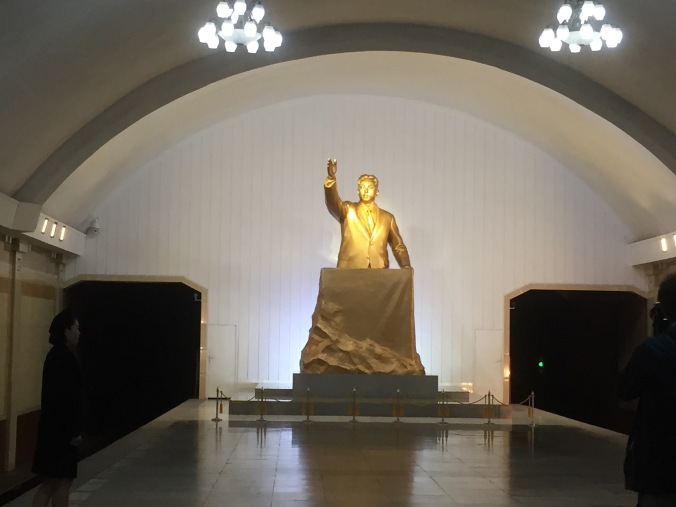
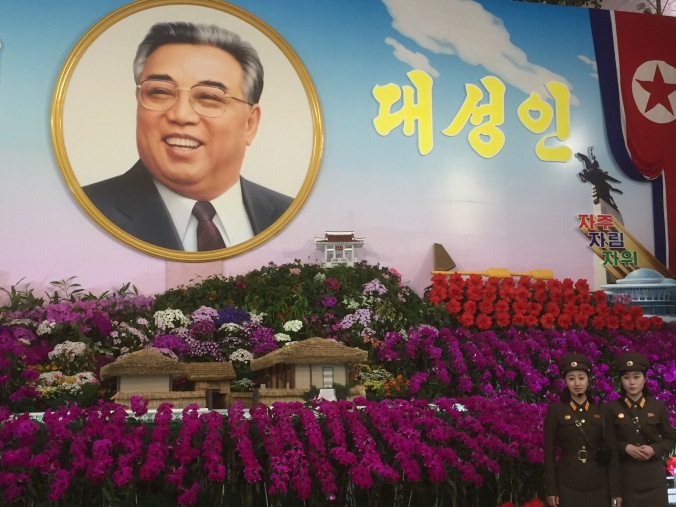
Remember this guy? The golden Kim Il Sung? He was where I left the discussion last time.

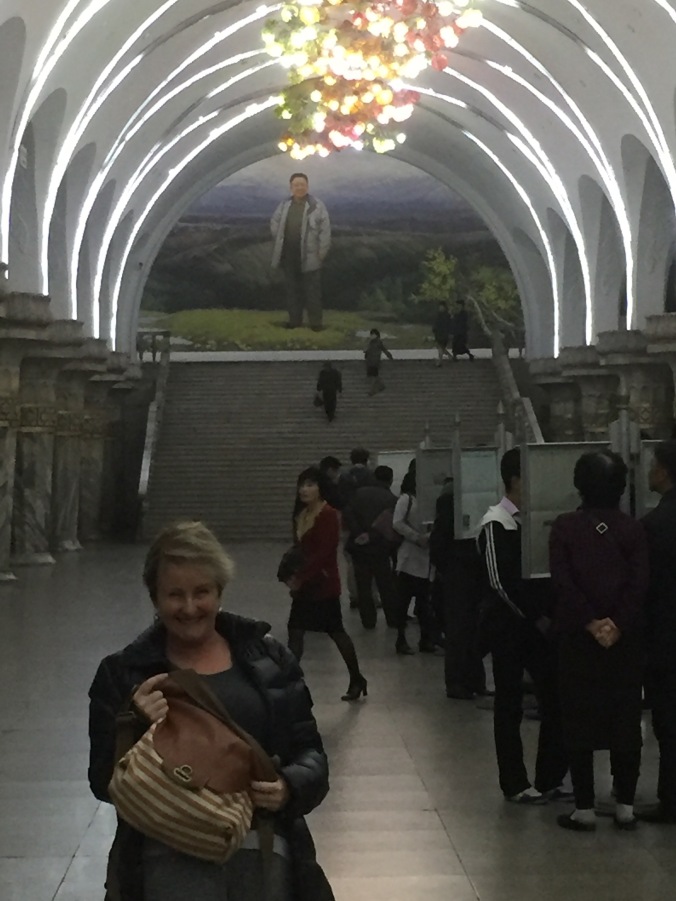
He is on one of the 3 decorated stations in the Pyongyang metro that we visited, larger than life and twice as golden. I want you to keep him in mind when we revisit the metro later in this post.  He isn’t the only item in the station I want to show you.

Last time we were talking about how The DPRK regime has clearly observed the power of advertising in the capitalist West and has used some of the tricks that work so well in the West, to instead endear themselves and their government to the North Korean population. Pictures and other visuals were a key component in gaining and then holding power.

As I’ve written about elsewhere, when Kim Il Sung came back to North Korea after WWII, North Korea had around 2.5 million illiterate people. Not surprisingly, there was a huge push for education. In 1946 the first University was built and in 1953 compulsory primary schooling was introduced. In the meantime, it makes sense that painting, murals and other visual arts would be crucial in gaining the largely illiterate population’s support for the new government and its programs.

This reliance on visual aids is still heavily used to this day.

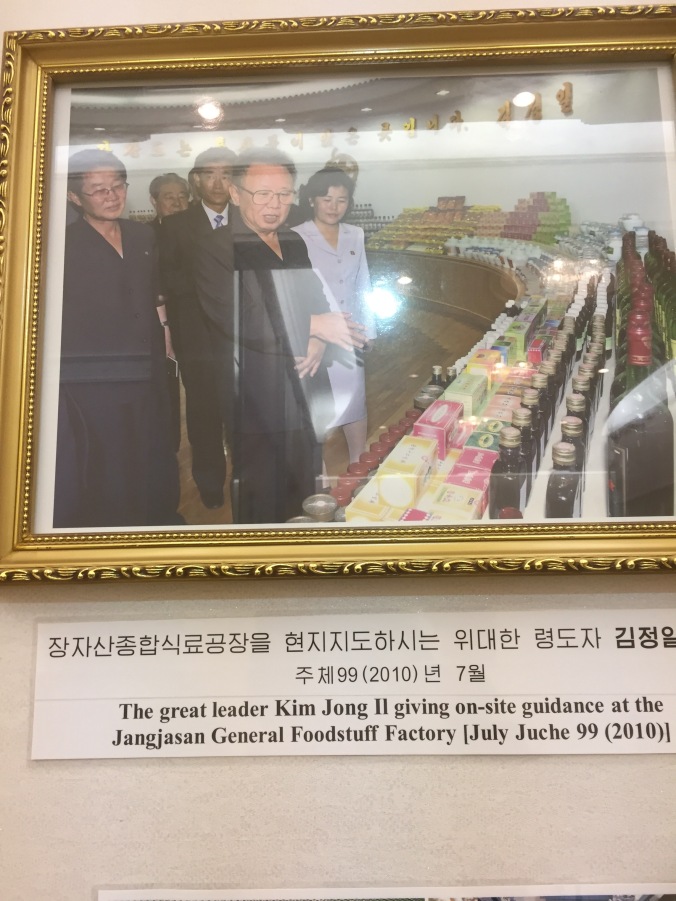
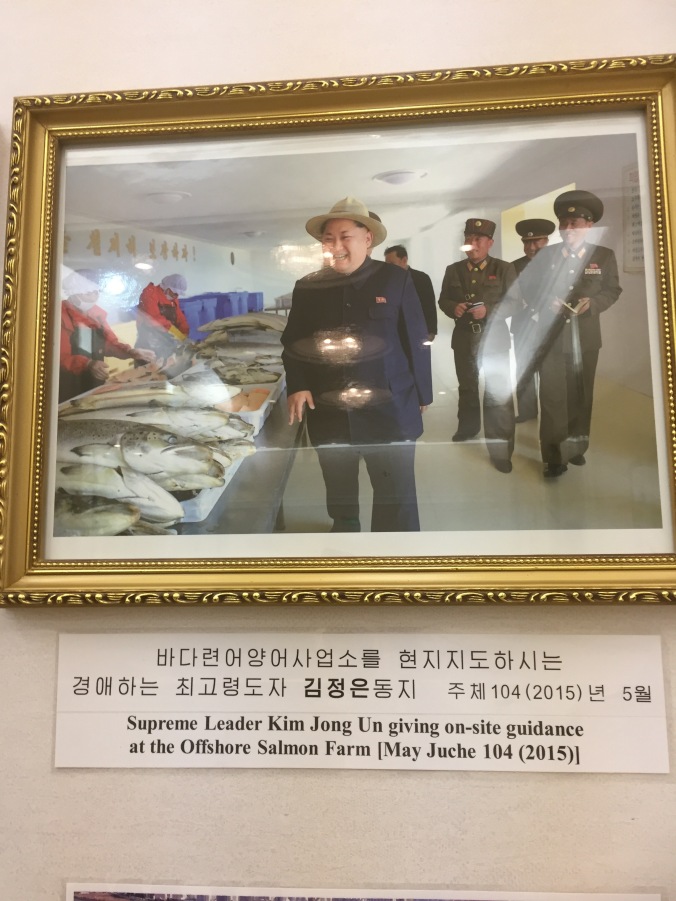
These two photographs (with the helpful English subtitles) were in the foyer of the 6-star hotel that we stayed in when we went into the country. Whenever any of the leaders visited a factory, school, mine or farm, photographers were clearly on hand to document the visit, with the photos and captions proudly displayed for evermore.

Do you notice the phrasing of the captions? It was always the same – the leaders were not just touring and observing… they were always giving “on-site guidance” because their knowledge is deeper and more intuitive than anyone else’s.

Notice too, how Kim Jong Un is smiling and others around are laughing. By all accounts, he’s a very funny man and when we were in North Korea we saw many photos of him looking like he was full of warmth and good cheer. But in the West, it’s rare we see any photos of him cracking a grin.

Photos aren’t the only images that are used. In every foyer, whether it be a school, a hotel or a public building, there are massive paintings of at least one of the older 2 leaders. This one was in the foyer of the primary school in Pyongsong that we toured. Kim Il Sung is surrounded by happy children, Kim Jong Il is over to the side looking adoringly at his father, while the children are in an idyllic place, with more children rushing to join them. They are shown literally hanging off the two leaders, as metaphors for the Korean people as a whole, being supported and uplifted by these two Great Men.

See the bouquet of flowers at the foot of the painting? They were fresh flowers, and I’d bet my bottom dollar that there’s a fresh bouquet brought there every day, probably by the families of the students. If I was running the school I’d have the flowers brought on a roster, with each family’s child/ren having the honour of bowing and laying the flowers down in front of the portrait. Nothing like teaching them young!

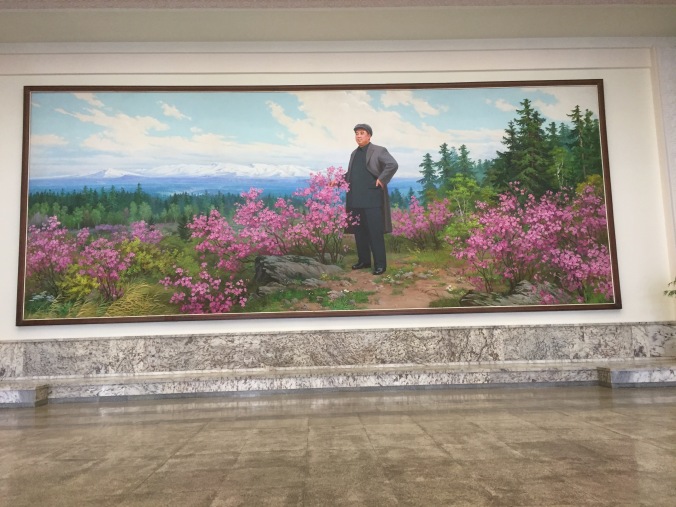
This portrait of Kim Il Sung is in the foyer of the Grand People’s Study House, which was built to honour him on his 70th birthday. It was probably one of the biggest paintings we saw and I regret that I didn’t have a person in the frame to show you how large it is.

Mt Paektu in the distance, which is the most sacred mountain in the Korean peninsula for both North and South Koreans, the pine forest behind him with its positive ions and the blossoms of the foliage with its renewal and growth after the hard times of winter. Everywhere the North Koreans go, they see paintings like this all around them. They are steeped in the mystique of Kim Il Sung, in particular.

And here we are down in the metro again. This is at the very end of Puhung Station. See the shine? This isn’t a painting – it’s a mosaic made up of very tiny tiles, entitled ‘The Great Leader Kim Il-Sung Among Workers’. This is one of many mosaics that decorate the walls of these stations. They are all incredibly nationalistic in style, usually with political images of the leaders and the workers, but sometimes with views of Pyongyang itself and of vistas showcasing Korea’s natural beauty.

Actually, when you walk up to get a closer view, you can’t help but notice that Kim Il Sung’s face has far more detail than the others’ faces.

These mosaics run the whole length of the stations. They must have taken ages to plan and complete.

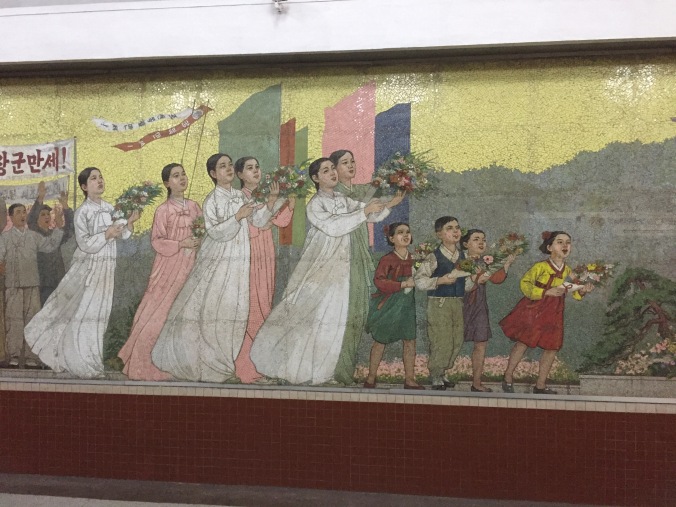
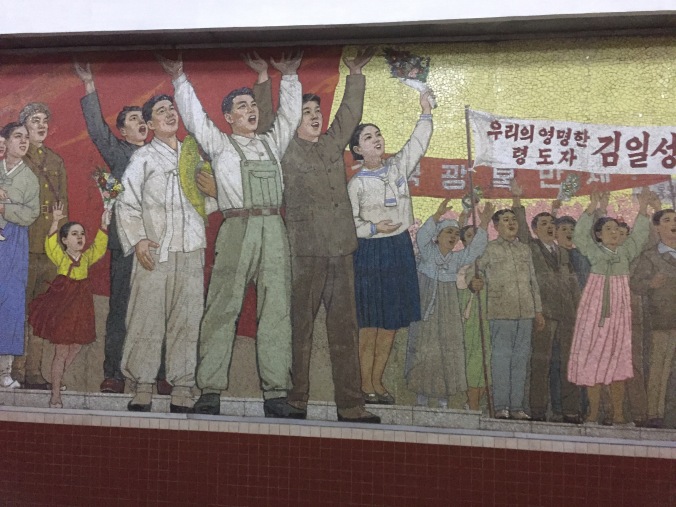
The next two photos are portions of the mosaics that run either side to the big gold statue of Kim Il Sung that is at the beginning of this post. Running for at least 30 feet alongside both platforms, these mosaics feature workers and citizens from all walks of life joyously celebrating the glory that is Kim Il Sung.

There’d be at least a hundred different figures all facing the statue, with their flags, signs and ecstatic expressions showing just how incredible their leader is. No matter where a commuter looks, there’s the evidence of how fortunate and blessed he or she is.

I’m sure by now you recognise the mountain behind Kim Jong Il! He’s standing in the worker’s parka that he wore in public in winter for the last decade or so of his life. Underneath that, he’s wearing the khaki uniform that again, he always wore in public to show that he was always working for the people and so didn’t have the time or the inclination to waste on dressing in expensive suits. (Sadly, in private it was another story. But the North Korean people haven’t an inkling of it.)

The lights in this station are meant to look like fireworks, celebrating all that he has done for and sacrificed for the country. Notice the newspapers in frames so the commuters can see what’s going on? When the people left and we were the only ones on the platform, we asked Mr Kim, one of our guides, what things were being reported on. The big news of the day was that it was the 30th anniversary of Kim Jong Il being appointed the head of some committee or other. Later on that day we saw women dancing in their national costumes in celebration of this.

The man has been dead since 2011! But still, they dance.

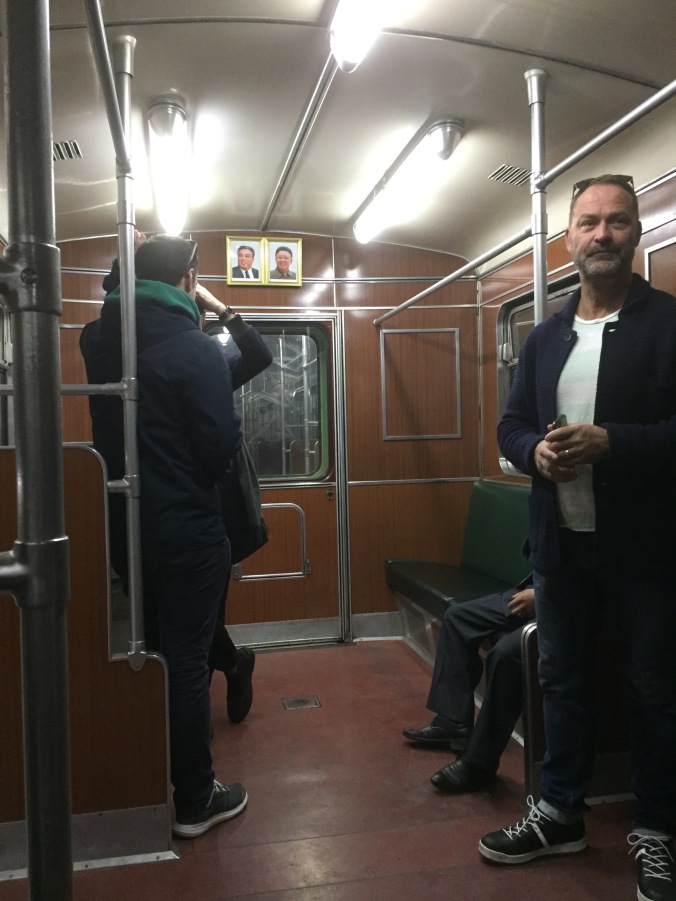
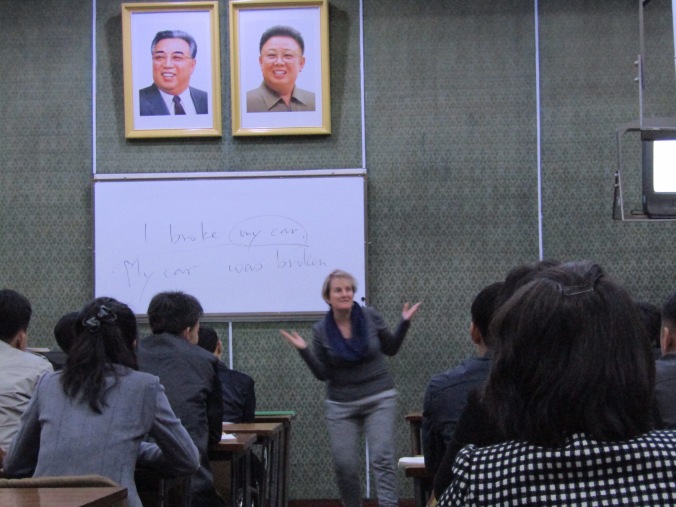
But BY FAR the most important images are these two. Every single house has them. Every single classroom, office, business, restaurant, factory … even, to my surprise, every single train carriage. No matter where a North Korean goes, these two faces are above them. These are the only shots used, so they are as familiar as the back of your own hand.

Every house is expected to have these hung up in the main living area. They are to be kept clean and dusted, and woe betide you if one gets broken. We were only in the DPRK for 10 days and even in that short space of time, we saw these faces so often that they became utterly familiar.

“Ah, there’s our mates!” we’d say as we walked under them. How much more powerful must it be if you were born under these faces and literally grew up under them all your life?

Here they are in the English classroom that I taught in at the Grand People’s Study House. They’re almost as big as me!

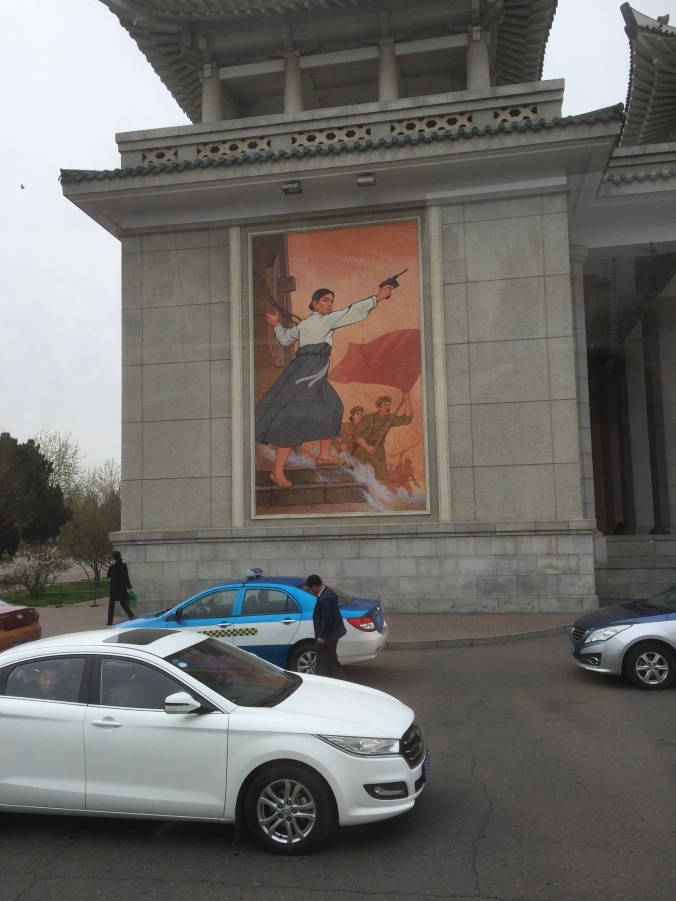
One morning towards the end of our tour, we went for a walk around central Pyongyang. By this stage, I had become very blasé about the pictures and signs, but I liked this one. It’s rare to see a woman featured at the forefront of a battle scene. This was one of a series of images on the side of the State Theatre.

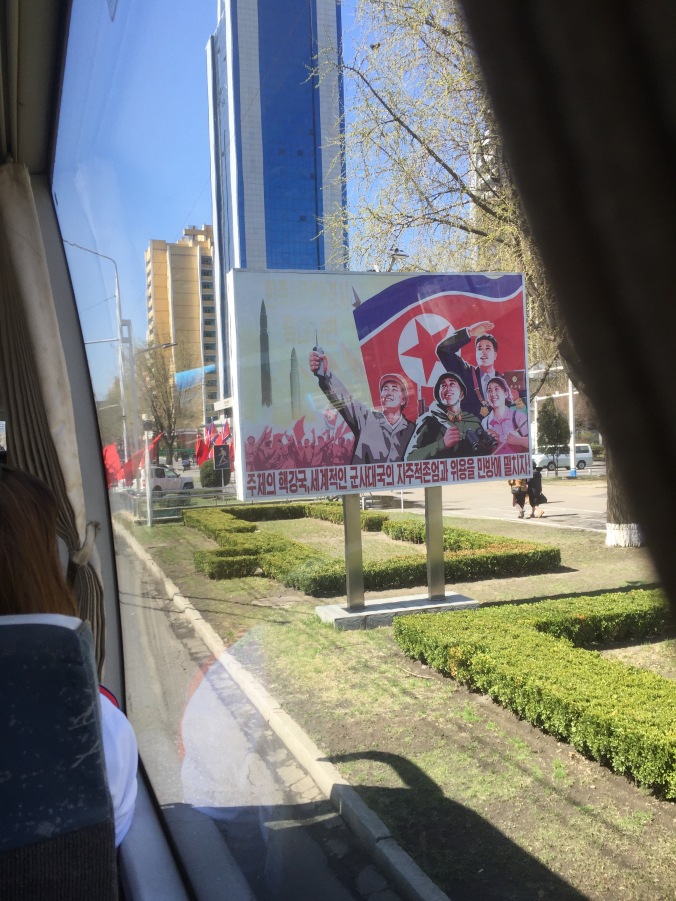
Dotted in and around Pyongyang and other cities were billboards like these. They were everywhere, usually with cheering, victorious soldiers, but I particularly liked this one with the nuclear missiles flying up above the cheering population. I don’t know what the words below mean.

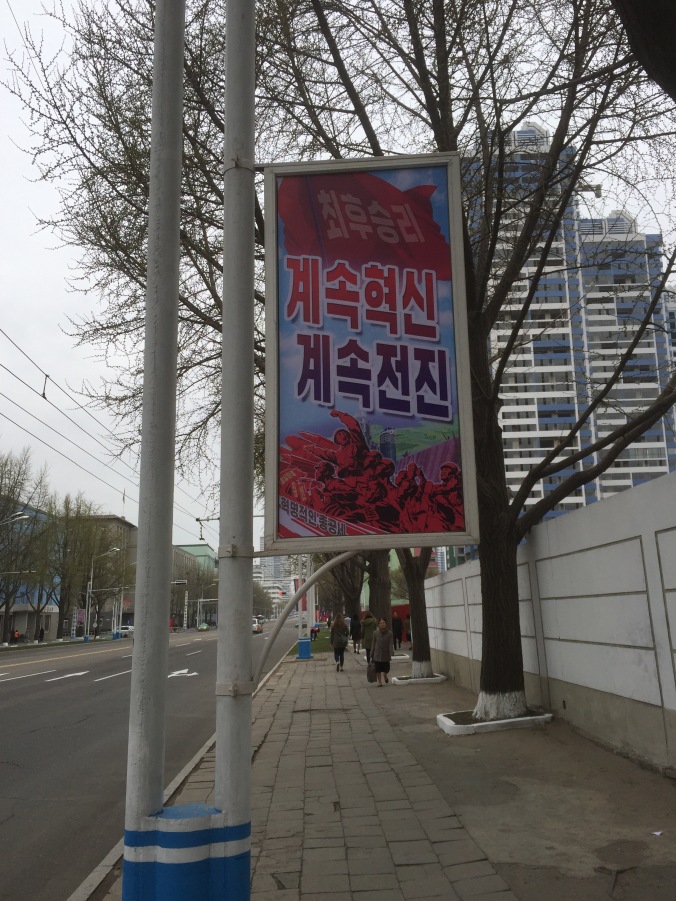
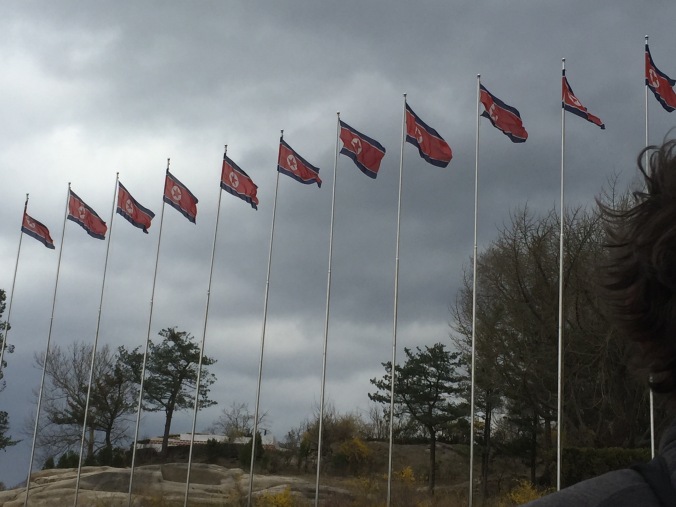
Every time you walk down the street, you are surrounded by images like this, or of the national flag.

Speaking of which, here it is.

It’s a clever design, with strong colours, (ironically the same red white and blue of the hated American Aggressors… and our flag too, come to think of it!), and it looks very effective when you see a whole heap of them in a line or grouped together on a street corner. The red star in the centre is placed everywhere. We noticed it a lot at the DMZ.

On our walk through Pyongyang, I decided to ask Un Ha, our other North Korean guide, what a couple of the signs were saying.  I couldn’t quite remember the exact wording, but I’ve got it down in my book as being something about the constant fight for reunification with South Korea and how they will never give up.

Aha! Another sign! I asked Un Ha what it was saying.

“We promise to uphold the leadership of Marshal Kim Jong Un with the utmost loyalty.”

It makes you wonder.

Here is a population being groomed to adore their government above all else, while we’re being groomed to believe that KFC is finger-lickin’ good, that Red Bull gives you wings, and that maybe she’s born with it – or maybe it’s Maybelline.

There’s more I want to show you. Advertising is incredibly powerful.


Advertising – North Korean style (1): Where leaders are larger than life.

A little while ago I was sitting at home on the couch,  a dog either side of me and one balanced on my lap with my laptop, reading blogs before going to work. It was about 6AM, still dark and pretty chilly, and I was filled with impotent anguish about having to grab my things and leave for work in the next 20 minutes to catch my train.

Be that as it may, that morning, as I was working my way down the list of blogs in my feed reader, I saw there was one by The Escape Artist. Ever since I heard Barney on the Choose FI podcast, I’ve been reading his blog. Turns out on this particular morning he’d written about advertising. If you haven’t already read it, go ahead. I’ll wait.

Barney wrote about the power of advertising. I loved his post, but one thing struck me. It’s all too easy to read about the hold that advertising has on us, particularly when we’re galloping along on the road to FI/RE, being frugal, getting out of debt and investing the surplus money we have kicking around.

“Oh yes, advertising is evil but it doesn’t affect me!” we say as we prepare our home-made dinner and settle into a night at home with a board game or book or Netflix binge.

But this is all slightly smug. How do we know how deeply or not we’re affected when we’re already neck-deep in a society that’s awash with consumerism? Is there any way to tell how advertising affects us when we’ve been bombarded with “Buy this!” “Subscribe to that!” since we were in our cradles?

There might be a way.

What if you were able to visit another society where consumer advertising was not and never has been a ‘thing’? That’s a huge point of difference right there. But instead of being indoctrinated into the joys of buying the latest fad, these people have been immersed in the advertising of a totally different kind of commodity.

Enter North Korea. Absolutely no consumer advertising whatsoever. Not so much as a single billboard about a single product. Instead, there’s advertising of a very different sort: the constant stream of adulation about the leaders and the regime who run the country.

The beauty of this trip for me was that because it’s indoctrination of a totally different sort to the one that we’re used to, it sticks out. We can observe how it’s being done and we can’t help but notice the effect it has on the population. Some of the methods they use are very obvious; others are more subtle, but they all tie together in an intricate jigsaw that holds the population in thrall. Probably like consumer advertising does with us.

The people of North Korea have absolutely no access to the internet. Their intranet has around 6 websites and they’re all run by the Government. Their tv is filled with patriotic songs, marches and military films of missiles going up and tanks being paraded around. Their ‘news’ programs are chock-full of absurd statistics of how well the country is doing in every conceivable way, under the wise and loving leadership of Marshal Kim Jong Un. Anyone coming into the country have their bags searched in case anyone tries to bring in literature such as travel books, newspapers and bibles.

I’ll be writing in the next few posts about how the government of North Korea has harnessed the power of advertising and has used it to sell itself to the people. This will take several posts to cover, as I want to look at a few different ways that they’ve manipulated sights, sounds and messages to convincingly sell their brand to the population. Just as advertisers work their psychological games out here in the West.

But first, a little background:

For around 150 years, up until WWII ended, North and South Korea was all one country under the control of Japan. The Japanese treatment of the Koreans was very harsh, to say the least. Korea was looked on as a resource to be exploited, with both its natural resources (such as gold, timber and fishing) and its people, being taken full advantage of.

Kim Il Sung was the first leader to take control after the Japanese were booted out after WWII and the Korean peninsula was divided arbitrarily into North and South by the Americans. He was a soldier in the USSR army during the war and the Russians put him into power in Korea when a leader was needed, but the North Koreans firmly believe that he was a freedom fighter against the Japanese and this was what caused the Japanese to leave Korea. They aren’t told about Hiroshima and Nagasaki. So Kim Il Sung was and will always be the saviour of the Korean people.

This belief is fostered in many ways. The use of statues is one that is used extensively throughout the country.

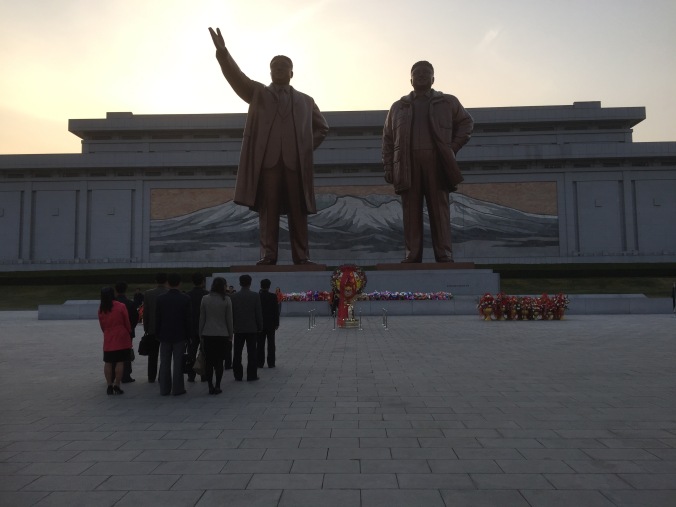
This photo is a place in the middle of Pyongyang which we reached as the sun was starting to go down. The people of North Korea love their current leader, but they absolutely revere the two leaders that have gone before him, particularly his grandfather, Kim Il Sung, (the one on the left.) Visitors to this site are encouraged to buy flowers, which they then lay at the feet of the Leaders, then you go back to your group and you all bow in unison. Then you quietly leave to make way for the next group.

The symbolism is obvious.

The whole area is laid out on a grand scale, with enough space for a few hundred people to gather. There is silence, enabling contemplation of the leaders and all that they’ve done for society. Their statues tower above us. There is a picture of Mt Paektu behind them, which is the most sacred of all the mountains in Korea, and where the second leader, Kim Jong Il, is said to have been born. (He wasn’t – he was actually born in Russia but the North Koreans don’t know that…)


It’s the custom for wedding parties to come and pay their respects to the Leaders on their happy day, which of course fosters closer links to the Leaders as they are tied into memories of important milestones in each person’s life. This group arrived as we were leaving. It is unthinkable not to visit the Leaders on a day such as this. Naturally, there are places like this in every town and city in the DPRK, so people can come and pay their respects; and to be seen to be coming and paying their respects, which is almost as important.

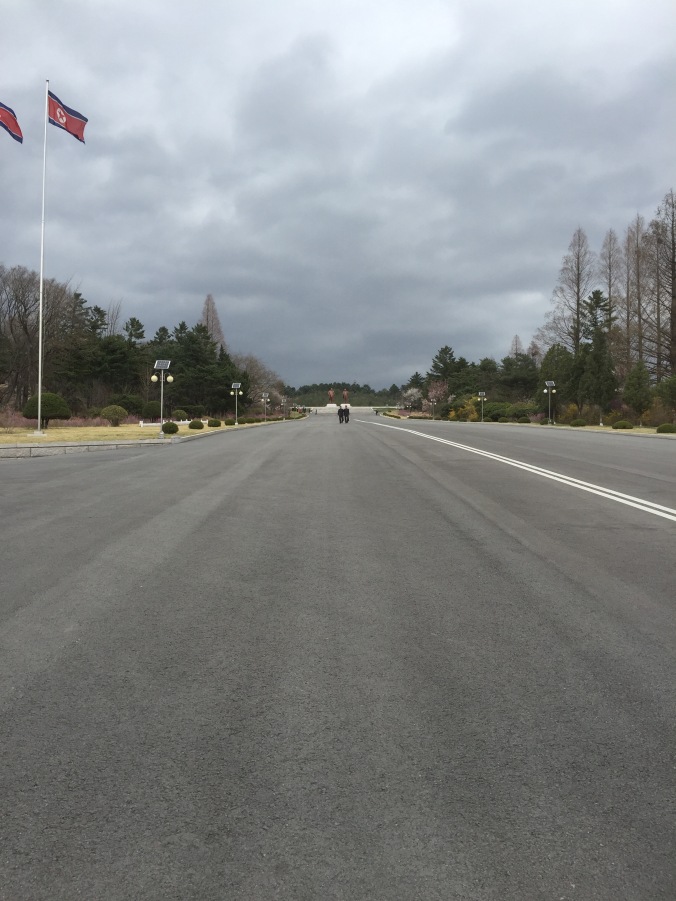
These statues were in a regional city that we went to for lunch after we visited the DMZ. It was a dull day and yet the bronze figures shone in the little light that was around.

Here is the way leading up to them. The two figures are set high above the city, with solar panels attached to the lights that illuminate them at night. Power blackouts are a frequent occurrence in the DPRK, but these statues will never be in darkness. The leaders will always be there, shining a constant light over the whole city as they gaze benignly down over all.

Again, the symbolism is obvious.

This is the ‘old town’, one of the few cities in North Korea that wasn’t flattened by the US bombing in the Korean War. This view is less than 2 minutes walk from the statues in the photo above. Compare the feeling of space and tranquillity around the statues compared to the cramped conditions here. Elsewhere in the town there are apartment blocks that date from after the Korean war, but these of course also have people living together in close quarters.

So much space, serenity, landscaping and light surrounding the images of the Leaders enlarges their importance in the minds of the population. It’s an effective piece of the jigsaw.

It’s not just in the towns. The pervasive cult of personality pops up everywhere. This is a statue located on a co-operative farm midway between the capital city of Pyongyang and the coast. This statue is huge, but it’s not anywhere near a large population base – it’s out in the middle of the countryside. The story behind this statue made my blood boil, but it also clearly illustrates the importance that the regime places on “advertising” itself to the people.

For around 30 years after the Korean war,  North Korea outstripped South Korea in terms of quality of life. Then came the collapse of the Soviet Union. Suddenly, there was no more food, machinery, fuel and financial help coming from a superpower to prop up Kim Il Sung’s grossly inefficient methods of running agriculture and industry. Within a couple of years, North Korea was plunged into a famine that lasted from 1994 – 1998 called ‘The Arduous March’. It’s difficult to know for certain just how many people starved to death during this time, due to the secretive nature of the government and the fact that many death certificates listed differing causes of death, but estimates range from 2 – 3.5 million. In a country with a population the same size as Australia, (25 million), that’s a significant proportion.

This particular co-op farm, growing mainly green vegetables and grains, had been visited a couple of times by Kim Il Sung during the 1980’s. The farmers asked him if they could put up a statue to celebrate the honour of his visits and he refused them, saying that it was unnecessary and that they were already doing important work.

Three years after he died, his son (Kim Jong Il) suggested that now was the time to build it and so here it is. The farm is so proud of it and it depicts actual people who were working there when Kim Il Sung came to visit. This story is all very nice and cosy…

… except if you’ve done your homework and you know that in 1997 famine was laying waste to millions of people in North Korea who were literally starving to death. People were eating grass, bark and anything they could to survive, particularly in the north of the country, far away from the major cities.

Meanwhile, here’s Kim Jong Il, in the middle of all this, telling a FARM to give up land and resources to erect a monument to his father. I don’t know that I could find a clearer story to illustrate just how important these symbols are to a government committed to portraying itself as the saviour of the Korean people. See how Kim Il Song cared about the farmers gathered, (dare I say… “worshipfully”) around him?

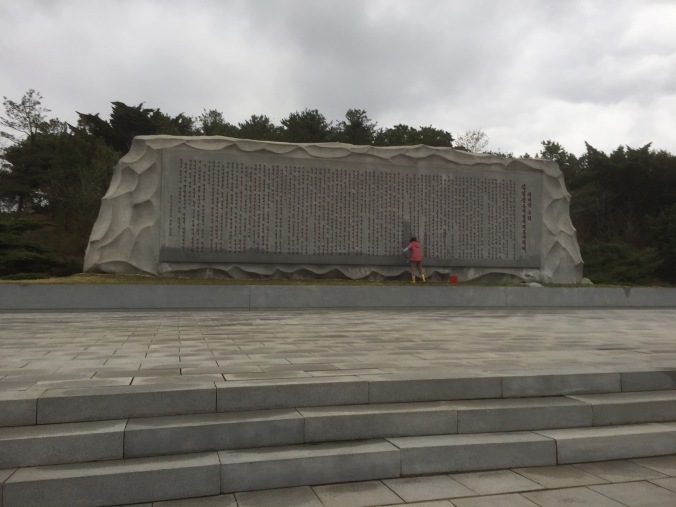
In the car park of the farm was this massive stone document, giving what I think are the words of one of the speeches Kim Il Sung gave when he came to the farm. It’s not just images of the Leaders that loom metaphorically and physically over the people, it’s their words as well.

The woman cleaning it wasn’t there purely to make it spick and span for our benefit – any images of the leaders and their words are expected to be kept immaculately clean at all times, as a mark of respect. Still, I’m sure she would’ve preferred to have been finished before a bus-load of tourists pulled up…

In a country with no billboards, video screens and magazine ads about anything other than how fortunate they are to have had such caring, capable and almost god-like leaders, it’s easy to see how huge monuments like these are an integral part of selling the sizzle. The people are told from infancy that their leaders are giants among men and are larger than life – and so how fitting it is for the population to see them literally depicted as such.

I’ll leave you with this photo taken in a station in the Pyongyang metro. Imagine seeing this every morning and evening on your commute…


Newer posts »